

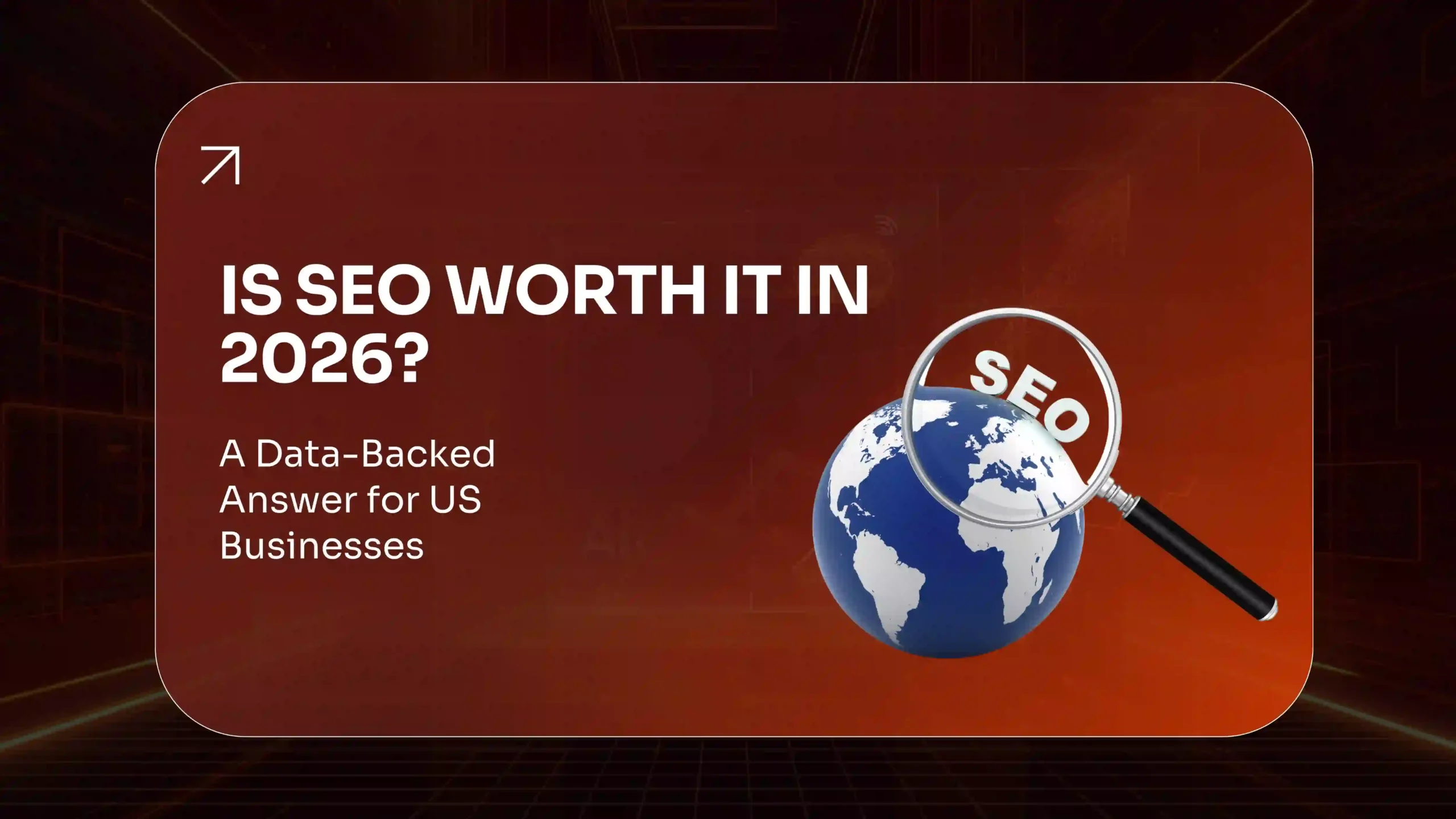
Is SEO Worth It in 2026? An Honest ROI Breakdown for US Businesses
Yes, SEO is still worth it in 2026 — but only for businesses that commit for 6–12 months and adapt to AI-driven search. Organic search remains the highest-margin acquisition channel for most US companies, with typical SEO ROI landing between 300% and 700% over a two-year window. What has changed is how you win: rankings alone no longer pay the bills — visibility inside AI Overviews, AI Mode, and answer engines does.
That’s the short version. Now let’s get into the part most agencies won’t tell you.
Search looks very different than it did two years ago. AI Overviews sit above the classic blue links. ChatGPT, Gemini, and Perplexity answer questions people used to type into Google. Zero-click searches are up, and plenty of business owners in Orlando, Tampa, and across Florida are asking a fair question: am I still getting anything for my SEO retainer?
This guide answers that honestly — with real cost ranges, realistic timelines, ROI math you can run yourself, and a clear list of situations where SEO genuinely isn’t worth your money. By the end, you’ll know whether SEO fits your business in 2026, and what a good program should actually look like.
What Is SEO in 2026? (And What It Has Become)
SEO in 2026 is the practice of earning visibility across every surface where people search — traditional Google results, AI Overviews, AI Mode, map packs, and large language models like ChatGPT and Perplexity.
The old definition — “getting to page one” — is now incomplete. A page-one ranking that sits below an AI Overview answering the same question earns a fraction of the clicks it did in 2022.
Modern search engine optimization services now cover four layers:
- Technical SEO — crawlability, indexing, site architecture, Core Web Vitals, and mobile-first performance
- On-page SEO — search intent matching, semantic depth, internal linking, and structured data
- Off-page SEO — backlinks, digital PR, brand mentions, and citations
- GEO/AEO — generative engine optimization and answer engine optimization, which shape how AI systems quote and cite your brand
If your provider is only doing the first three, you’re running a 2022 playbook in a 2026 market. You can see how the layers fit together in our breakdown of what on-page SEO services include.
What Changed in Search Between 2024 and 2026
Four shifts reshaped the economics of organic traffic.
1. AI Overviews became normal, not novel. Google now generates summary answers for a large share of informational queries. Google’s own guidance on AI features in Search confirms that eligibility comes from standard indexing and content quality — not a separate optimization channel.
2. Zero-click searches grew. More queries end without a website visit. This hits definitional and quick-fact content hardest, and barely touches transactional and local queries.
3. LLM referral traffic became a real channel. Visits from ChatGPT, Perplexity, Gemini, and Copilot now appear in analytics for most sites. The volume is smaller than Google’s, but the intent quality is often higher because users arrive already educated.
4. Trust signals got heavier. Google’s Helpful Content guidance and the E-E-A-T framework mean thin, unattributed, AI-spun content struggles to hold rankings through core updates.
The takeaway: search didn’t shrink. It fragmented. Businesses that optimized for one channel lost ground. Businesses that optimized for visibility gained it.
Is SEO Dead? What AI Overviews Actually Did to Organic Traffic
No, SEO is not dead — but informational blog traffic took a real hit, while commercial and local traffic held steady or grew.
Here’s the pattern most US sites are seeing:
| Query type | Example | AI Overview impact |
|---|---|---|
| Definitional / informational | “what is a CRM” | Heavy CTR loss |
| Comparison / evaluation | “Webflow vs WordPress” | Moderate loss, still valuable |
| Commercial investigation | “best SEO agency Orlando” | Minimal loss |
| Transactional | “SEO services pricing” | Little to no loss |
| Local / near me | “SEO company near me” | Map pack still dominant |
That table explains why two businesses can run identical SEO budgets and report opposite results. A publisher living on “what is” traffic is hurting. A service business in Central Florida ranking for “Orlando SEO services” is not.
Practical implication: if your content strategy is built on top-of-funnel definitions, rebalance toward comparison, pricing, and local intent pages. Our guide on how to do keyword research for leads walks through exactly how to identify which queries still convert.
SEO ROI: What Businesses Actually Earn Back in 2026
SEO ROI is calculated as: (Revenue from organic − SEO cost) ÷ SEO cost × 100.
Across industries, typical outcomes look like this over a 24-month program:
- Local service businesses (home services, dental, legal, HVAC): 400%–700% ROI, driven by high close rates on local leads
- B2B services and SaaS: 250%–500% ROI, slower to start but strong lifetime value
- Ecommerce: 200%–450% ROI, highly dependent on margin and category competition
- Local retail / restaurants: 300%–600% ROI, almost entirely from local pack visibility
These are ranges, not promises. Two variables move them more than anything else: average customer value and close rate on inbound leads.
Run the math yourself
A simple model:
- Monthly organic sessions you can realistically reach × conversion rate = leads
- Leads × close rate = customers
- Customers × average order value (or lifetime value) = monthly revenue
- Compare against monthly SEO cost
Worked example — an Orlando roofing company:
- Target: 1,800 organic sessions/month by month 10
- Lead conversion: 3.5% → 63 leads
- Close rate: 18% → 11 customers
- Average job value: $9,500 → $104,500/month
- SEO investment: $3,500/month
Even after halving those assumptions for conservatism, the channel pays for itself several times over. That’s the reason local SEO is the strongest ROI segment in 2026.
Note: this is a modeled scenario using typical industry benchmarks, not a specific client result. Always build your own model with your real close rate and job value.
How Much Does SEO Cost in the USA in 2026?
SEO pricing in the US generally falls into these bands:
| Delivery model | Typical monthly cost | Best fit |
|---|---|---|
| DIY | $0–$300 (tools only) | Solo founders, very local, high time availability |
| Freelancer | $500–$2,000 | Single-location small business, narrow scope |
| Boutique/mid-size agency | $2,000–$7,500 | SMBs and multi-location businesses |
| Enterprise agency | $8,000–$30,000+ | National brands, large ecommerce, competitive verticals |
| In-house team | $10,000–$25,000 (loaded salary) | Companies with ongoing, large-scale content needs |
Florida and Orlando pricing typically runs 10–20% below major-metro rates like New York or San Francisco, while national-level campaigns priced from Florida agencies remain competitive with anywhere in the US.
Two red flags on price:
- Under $500/month for a competitive market. That budget usually buys automated reports and low-quality links, not strategy.
- Vague deliverables at any price. If the proposal doesn’t specify deliverables, KPIs, and reporting cadence, you’re buying hours, not outcomes.
For a full breakdown by service tier, see our SEO services cost and USA pricing guide. If you’re weighing a results-based structure, we also cover performance-based SEO and when it makes sense.
How Long Does SEO Take to Show Results in 2026?
Most businesses see early movement in 3 months, meaningful lead flow at 6 months, and full compounding returns between 9 and 18 months.
A realistic timeline:
Months 1–3 — Foundation Technical audit and fixes, keyword and intent mapping, on-page optimization, Google Business Profile cleanup. Expect impression growth, ranking movement on long-tail queries, and few conversions.
Months 4–6 — Traction Content clusters published, internal linking built, first authority links earned. Mid-tail rankings enter positions 5–20. First consistent organic leads arrive.
Months 7–12 — Compounding Topical authority takes hold. Competitive commercial keywords reach page one. Cost per lead from organic typically drops below paid.
Months 12+ — Leverage New pages rank faster because domain authority and topical authority carry them. This is where SEO’s compounding returns separate it from paid channels.
Anyone promising page-one rankings in 30 days for a competitive term is either misrepresenting the work or targeting keywords nobody searches. Our detailed article on how long SEO takes to show results breaks this down month by month.
SEO vs PPC: Which Is Better for Your Business in 2026?
Neither is universally better. They solve different problems.
| Factor | SEO | Google Ads / PPC |
|---|---|---|
| Speed to first lead | 3–6 months | Days |
| Cost per lead over time | Falls | Rises with competition |
| Traffic when you stop paying | Continues (decays slowly) | Stops immediately |
| Trust signal | High (earned) | Lower (labeled ad) |
| Best for | Compounding growth, brand authority | Launches, promotions, testing |
| Attribution clarity | Harder | Easier |
The honest recommendation for most US SMBs: run both, weighted by stage. If you need leads next week, start with paid. If you want your cost per acquisition to fall over 24 months, start SEO now and let it mature underneath your ads.
There’s also a compounding benefit to running them together: paid search data tells you which keywords actually convert, which then informs your SEO priorities. We cover this in depth in our SEO vs PPC B2B ROI comparison and our guide to Google Ads for B2B.
When SEO Is NOT Worth It — An Honest List
Any agency that tells you SEO is right for every business is selling, not advising. Here’s when we tell prospects to spend elsewhere.
1. You need revenue within 60 days. SEO won’t save a cash-flow emergency. Use paid search, outbound, or partnerships.
2. Your budget is under $500/month in a competitive market. You’ll spend real money and get no result, which is worse than spending nothing.
3. You can’t commit for at least 6 months. Stopping at month four means paying for the investment phase and quitting before the return phase.
4. Your product has near-zero search demand. Genuinely new categories have no one searching for them yet. Demand generation comes first — see our demand gen vs lead gen breakdown.
5. Your margins can’t absorb the cost. If average order value is $25 with a 15% margin, the math rarely works without huge volume.
6. Your website can’t convert. Sending traffic to a page that converts at 0.3% is pouring water into a bucket with a hole in it. Fix conversion first — start with our website conversion rate guide.
7. You’re relying entirely on one-off informational blog traffic. That’s the segment AI Overviews hit hardest.
If two or more of these apply to you, be honest with yourself and revisit SEO in two quarters.
Local SEO: The Highest-ROI Segment in 2026 (Orlando & Florida Focus)
Local SEO is the single strongest ROI play in 2026 because AI Overviews barely disrupt “near me” intent, and the local pack still dominates the mobile screen.
If you serve customers in Orlando, Winter Park, Kissimmee, Lake Nona, Altamonte Springs, or anywhere in Central Florida, this is where your money works hardest.
What actually moves the needle locally
Google Business Profile optimization. Complete categories, service areas, products, hours, and weekly posts. Follow Google’s Business Profile guidelines precisely — suspensions are costly and slow to reverse.
Review velocity and response. Consistent new reviews with owner responses outperform a static high star rating. Aim for steady monthly volume, not a burst.
NAP consistency and citations. Your name, address, and phone must match exactly across every directory. Inconsistency is one of the most common causes of stalled local rankings.
Location and service landing pages. Not thin duplicates. A real page for each service-and-city combination — “Orlando roofing SEO,” “Tampa dental SEO,” “Fort Lauderdale HVAC SEO” — with local proof, testimonials, and specifics.
Local link building. Chamber of commerce, local sponsorships, Central Florida news mentions, and industry associations still carry disproportionate weight for local pack ranking.
Proximity-aware content. Reference neighborhoods, landmarks, and service radius naturally. This helps both Google and AI systems understand where you operate.
For a full implementation walkthrough, see our local SEO guide for home services businesses and our small business SEO playbook for 2026.
Florida-specific note: competition in Orlando is meaningfully lower than Miami or Tampa for most service verticals. Businesses in Central Florida can often reach page one for high-value commercial terms in 6–9 months — a timeline that would take 12–18 months in a larger metro.
GEO and AEO: How to Get Cited by AI Overviews, ChatGPT, and Perplexity
Generative Engine Optimization (GEO) and Answer Engine Optimization (AEO) are how you earn citations inside AI-generated answers rather than just links on a results page.
Here’s what consistently works.
1. Answer the question in the first 40–60 words. AI systems extract concise, self-contained answers. Bury the answer under 300 words of preamble and you won’t be quoted.
2. Take a clear position. Hedged, “it depends” content rarely gets cited. Decisive answers with qualifiers (“Yes, but only if…”) get pulled far more often.
3. Use question-formatted headings. H2s and H3s phrased as real user questions map directly to how answer engines parse pages.
4. Add original data. Proprietary statistics, survey results, or documented case studies are the single strongest citation magnet. Content that only restates what’s already indexed has nothing quotable.
5. Implement structured data. FAQPage schema, Article, Organization, and LocalBusiness markup help machines parse your entities and relationships.
6. Build entity consistency. Your brand name, services, location, and people should be described identically across your site, your Google Business Profile, LinkedIn, and third-party directories. LLMs build entity understanding from repetition across sources.
7. Keep paragraphs to 2–3 sentences. Extractability is a formatting problem as much as a content problem.
8. Earn brand mentions, not just links. LLMs weight unlinked brand mentions in reputable sources. Digital PR now serves double duty — see our SEO outreach services guide.
The core insight: GEO is not a replacement for SEO. Every AI system draws from the search index. Strong technical foundations and topical authority remain prerequisites — GEO is the layer on top.
Do Backlinks Still Matter in 2026?
Yes — but quality and relevance now matter far more than volume, and links increasingly function as trust signals for AI systems too.
What still works:
- Digital PR and data-driven assets that journalists genuinely want to cite
- Relevant industry publications in your actual vertical
- Local and regional links for geo-targeted businesses
- Genuine partner and supplier links
What no longer works: bulk directory submissions, private blog networks, comment spam, and cheap guest post packages. These now carry more downside risk than upside.
A useful benchmark: ten highly relevant links from real sites outperform a thousand from link farms — and only the first group influences whether an AI system treats you as an authority.
How to Measure SEO ROI Accurately
Most SEO reporting fails because it measures activity instead of outcomes. Here’s a measurement stack that survives a CFO’s scrutiny.
Tier 1: Business metrics (report these to leadership)
- Organic-sourced revenue
- Organic-sourced qualified leads
- Cost per acquisition from organic vs paid
- Customer lifetime value by channel
- Pipeline influenced by organic
Tier 2: Leading indicators (report these monthly)
- Organic sessions segmented by intent (informational vs commercial)
- Conversion rate by landing page
- Share of voice on target keyword sets
- Local pack rankings by service and city
- AI Overview and LLM citation appearances
Tier 3: Diagnostics (for your team, not the board)
- Indexation coverage in Google Search Console
- Core Web Vitals by template
- Internal link depth to money pages
- Content decay — pages losing traffic quarter over quarter
Attribution in an AI-first world
Attribution has genuinely gotten harder. Someone reads your article, asks ChatGPT a follow-up, sees your brand cited, then searches your name directly and converts. Standard analytics logs that as branded direct traffic.
Three practical fixes:
- Track branded search volume as an SEO outcome, not a vanity metric. Rising branded search is often the clearest signal SEO is working.
- Add a “how did you hear about us” field to your lead forms. Self-reported attribution catches what analytics misses.
- Segment referral traffic from AI platforms in GA4 so you can see LLM-driven visits separately.
DIY vs Freelancer vs Agency vs In-House: Which Should You Choose?
| Option | Pros | Cons | Best when |
|---|---|---|---|
| DIY | Lowest cash cost, deep product knowledge | Slow, steep learning curve, opportunity cost | Very local, low competition, founder has 10+ hrs/week |
| Freelancer | Affordable, flexible, direct access | Limited bandwidth, single skill set, key-person risk | Narrow scope, single location, tight budget |
| Agency | Full skill coverage, tools, cross-industry pattern recognition | Higher cost, variable quality | Multi-service or multi-location growth |
| In-house | Full control, brand immersion | Expensive, hard to hire, hard to cover all disciplines | Content is a core product, large ongoing volume |
The realistic middle path for most US SMBs: a specialist agency for strategy, technical work, and link building, plus one in-house person owning content and coordination. We compare the trade-offs in detail in should you outsource SEO.
Signs Your SEO Agency Isn’t Working
Watch for these:
- Reports full of rankings and impressions but no leads or revenue
- No technical audit in the first 60 days
- Content published on a schedule with no keyword or intent rationale
- Backlinks from irrelevant, low-quality domains
- No mention of AI Overviews, GEO, or entity optimization anywhere in strategy
- You can’t get a straight answer about what was done last month
- Zero conversion rate optimization input on landing pages
Reasonable checkpoint: by month three you should have a completed technical audit, a documented keyword and content plan, measurable ranking movement on long-tail terms, and clean tracking in place. By month six, leads. If not, ask hard questions.
Which Industries Benefit Most from SEO in 2026?
Ranked by typical ROI:
- Home services (roofing, HVAC, plumbing, remodeling) — high job value, urgent local intent
- Legal — very high case value absorbs competitive costs; see our law firm SEO guide
- Healthcare and dental — strong local intent and repeat patient value; see our healthcare SEO guide
- B2B services and SaaS — long sales cycles but exceptional lifetime value
- Ecommerce — depends heavily on margin and category; see our ecommerce SEO guide
- Real estate and financial services — high value, high compliance requirements
- Local retail and hospitality — map pack driven, strong return on modest budgets
Lowest fit: commodity products with razor-thin margins and no local component.
Why Choose Leads 360 LLC
We build SEO programs designed around revenue, not rankings.
What makes our approach different:
- Revenue-first reporting. Every monthly report leads with leads and pipeline, not impressions.
- GEO and AEO built in from day one. Structured data, entity optimization, and citation-ready content are standard, not upsells.
- US market specialization. We serve businesses nationwide with deep expertise in Florida and the Orlando metro — including Winter Park, Kissimmee, Lake Nona, and Central Florida service areas.
- Full-stack capability. SEO alone can’t fix a slow or poorly converting site. Our web development and custom software development teams work alongside SEO so technical fixes actually ship.
- Honest scoping. If SEO isn’t the right channel for your stage, we’ll tell you and point you toward performance marketing instead.
Explore our full SEO services in the USA, browse all services at Leads 360 LLC, or learn more about our team.
Frequently Asked Questions
Is SEO worth it in 2026? Yes, for most businesses with a 6+ month horizon and at least $1,500/month to invest. Typical ROI ranges from 300%–700% over two years, with local service businesses seeing the strongest returns. It is not worth it if you need revenue within 60 days or can’t commit past month four.
Is SEO dead because of AI? No. Informational blog traffic declined due to AI Overviews, but commercial, transactional, and local search traffic held steady. Search volume didn’t shrink — it fragmented across Google, AI Overviews, and LLMs. Optimizing for all three is now the job.
How long does SEO take to show results in 2026? Early ranking movement appears at 3 months, consistent leads at 6 months, and compounding returns between 9 and 18 months. Local businesses in less competitive markets like Orlando often move faster than the national average.
How much does SEO cost per month in the USA? Freelancers charge $500–$2,000, mid-size agencies $2,000–$7,500, and enterprise agencies $8,000–$30,000+. Florida and Orlando rates typically run 10–20% below major-metro pricing. Anything under $500/month in a competitive market rarely produces results.
Is SEO better than Google Ads for small business? They serve different purposes. Google Ads delivers leads within days but stops the moment you stop paying. SEO takes 3–6 months but produces compounding returns and a falling cost per acquisition. Most successful SMBs run both.
How do I get my site into Google AI Overviews? Answer the target question in the first 40–60 words, use question-formatted headings, add FAQPage and Article schema, include original data or case studies, and keep paragraphs to 2–3 sentences. There’s no separate submission process — AI Overviews draw from the standard search index.
Do backlinks still matter in 2026? Yes, but relevance and authority now far outweigh volume. Ten links from genuinely relevant industry sites outperform hundreds from directories or link networks. Links also influence how AI systems assess brand authority.
Is local SEO worth it for service businesses? Local SEO is the highest-ROI SEO segment in 2026. “Near me” and city-specific queries are the least disrupted by AI Overviews, and the local pack still dominates mobile screens. For home services, legal, dental, and trades businesses, it’s usually the first place to invest.
What happens if I stop doing SEO? Rankings typically hold for 2–4 months, then decline gradually as competitors publish and Google recrawls. Technical debt accumulates and content decays. Unlike paid ads, the drop is slow — which makes it easy to underestimate until traffic has fallen 40% or more.
What’s the difference between SEO and GEO? SEO optimizes for ranking in search results. GEO (Generative Engine Optimization) optimizes for being cited inside AI-generated answers from Google AI Overviews, ChatGPT, Perplexity, and Gemini. GEO builds on SEO — it doesn’t replace it, because AI systems still draw from the search index.
The Bottom Line: Is SEO Worth It in 2026?
SEO in 2026 is worth it for businesses that treat it as a compounding asset rather than a monthly expense — and it’s a waste of money for businesses that quit at month four.
The channel didn’t get worse. It got harder to fake. Thin content, cheap links, and ranking-report theater stopped working, which is genuinely good news for anyone willing to do the real work.
Three things determine whether it pays off for you:
- Commitment window. Twelve months, not three.
- Intent alignment. Commercial and local queries over generic informational ones.
- Execution quality. Technical foundations, genuine authority, and GEO-ready content.
If you can commit to those, SEO remains the most durable customer acquisition channel available to US businesses — and the only one that gets cheaper as it gets bigger.
Ready to find out if SEO is worth it for your business?
Get a free, no-obligation SEO opportunity assessment from Leads 360 LLC. We’ll analyze your current visibility, benchmark your competitors, model your realistic ROI, and tell you honestly whether SEO is the right investment right now — even if the answer is no.
👉 Book your free consultation with Leads 360 LLC or explore our advanced SEO services for the USA, Florida, and Orlando.
Want to keep reading first? Start with our technical SEO audit checklist for 2026 or our digital marketing outlook for 2026.