


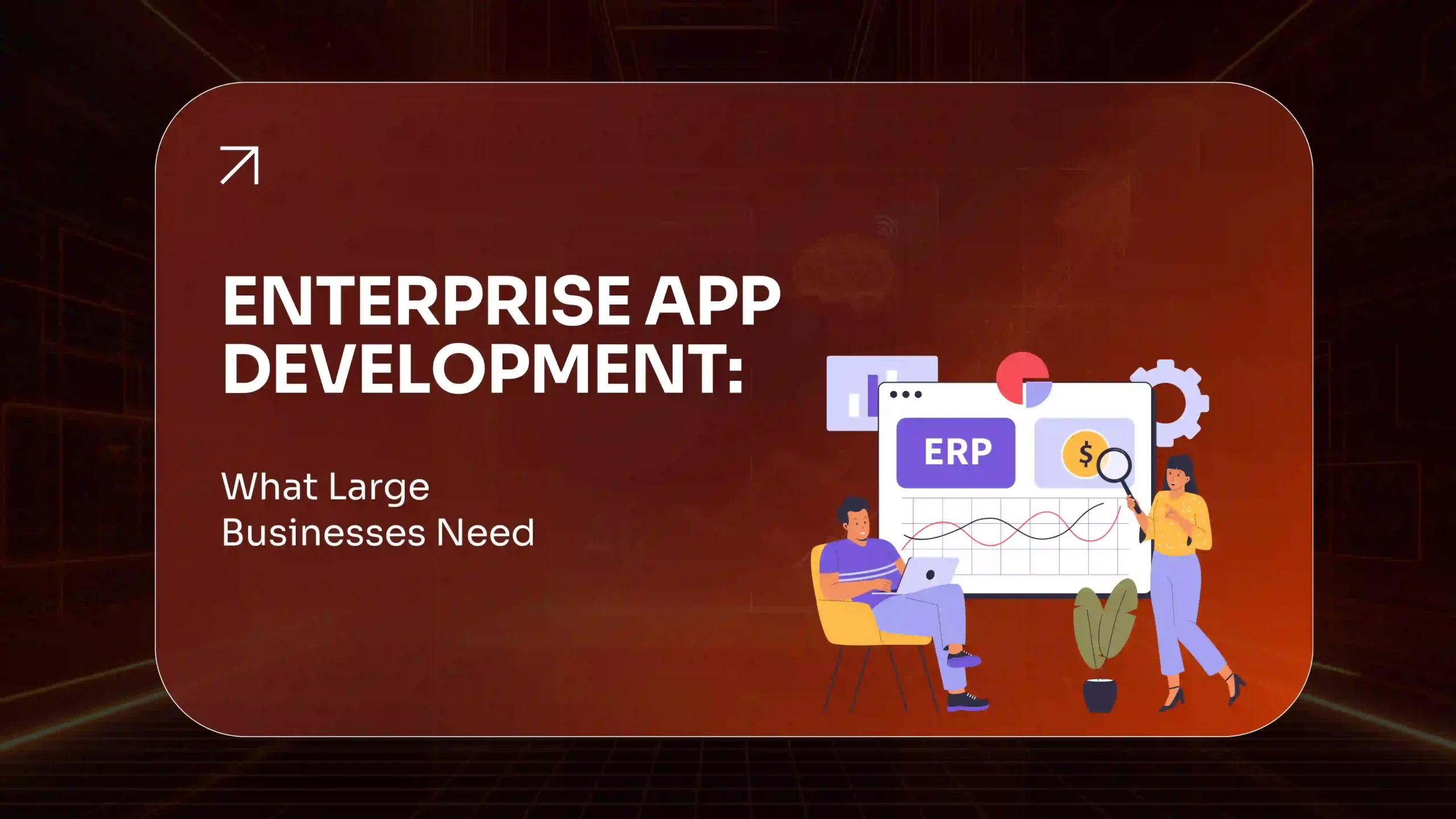
Enterprise App Development: What Large Businesses Need in 2026
Building an app for a large business is nothing like building one for consumers. There’s no App Store ranking to chase and no viral growth loop to engineer. Instead, there are 4,000 employees who need the thing to work on day one, a 12-year-old ERP system that refuses to speak modern API, a security team with veto power, and a CFO asking what the payback period looks like.
This guide walks through what enterprise app development actually requires — architecture, security, integration, budget, timelines, and the vendor questions that separate a smooth rollout from an expensive rewrite. It’s written for CTOs, IT directors, product owners, and operations leaders who are scoping a real project, not browsing definitions.
Let’s get into it.
What Is Enterprise App Development?
Enterprise app development is the process of designing, building, integrating, securing, and maintaining software applications that support the operations of a large organization. Unlike consumer apps, enterprise applications must connect to existing business systems, enforce role-based access, meet regulatory compliance standards, and scale reliably across thousands of users.
That definition sounds tidy, but the work rarely is. An enterprise application development project typically touches finance, HR, IT security, legal, and at least two business units that disagree about requirements. The software is only half the deliverable — the other half is fitting it into a live organization without breaking anything.
Enterprise apps come in many shapes: internal employee productivity tools, field service platforms, custom CRM systems, supply chain management software, business intelligence dashboards, and customer-facing portals backed by enterprise infrastructure. What unites them is scale, integration depth, and consequence. When a consumer app crashes, someone shrugs. When a warehouse management app crashes, trucks stop.
If you’re still deciding whether a custom build makes sense at all, our breakdown of the signs you need custom software development is a useful reality check before you commit budget.
Enterprise Apps vs. Consumer Apps: The Key Differences
The core difference is choice. Consumer apps compete for voluntary downloads; enterprise apps are assigned. That single fact changes everything about how they’re designed, secured, integrated, and measured.
Here’s how that plays out in practice.
Users don’t opt in — so adoption is a design problem
A consumer app that annoys people gets deleted. An enterprise app that annoys people gets used badly — workarounds, shadow spreadsheets, incomplete data entry. Poor UX doesn’t show up as churn; it shows up as garbage data six months later.
That’s why UI/UX design for enterprise software deserves real investment, even for internal tools. The measure isn’t delight. It’s task completion speed and error rate.
Integration is the product, not a feature
Consumer apps often stand alone. Enterprise applications almost never do. Your new app will need to read from an ERP, write to a CRM, authenticate through an identity provider, push events to a data warehouse, and respect permissions defined somewhere else entirely.
A useful rule of thumb from enterprise delivery teams: on a typical large-business project, integration and data migration consume 30–50% of total engineering effort. Teams that budget for “the app” and treat integrations as an afterthought are the ones that miss deadlines.
Our API integration services guide covers the patterns that hold up under enterprise load.
Security and compliance are entry requirements
Consumer apps aim for reasonable security. Enterprise apps must satisfy auditors. Depending on your industry, that means GDPR, HIPAA, SOC 2, PCI DSS, or all four — plus internal policies that are often stricter than the regulation itself.
The buyer isn’t the user
In enterprise software, procurement, IT, and end users are three different audiences with three different definitions of success. Good enterprise app development services manage all three deliberately.
Lifespan is measured in years
Consumer apps get rebuilt every few years. Enterprise applications routinely run for a decade. That makes maintainability, documentation, and architectural discipline far more valuable than shipping speed.
The Main Types of Enterprise Applications
Most enterprise software falls into one of three delivery models, and knowing which one you’re building shapes nearly every downstream decision.
B2E (Business-to-Employee)
Internal apps built for your own workforce: HR self-service portals, field technician apps, inventory scanners, approval workflows, internal knowledge tools. Adoption is mandatory, so ROI is measured in hours saved and errors avoided.
Common examples: shift scheduling apps, expense approval tools, warehouse pick-and-pack apps, sales enablement platforms.
B2B (Business-to-Business)
Applications your business partners, distributors, or corporate clients use: dealer portals, supplier collaboration platforms, partner ordering systems, white-labeled client dashboards. These need strong multi-tenancy, granular permissions, and audit logging.
B2C at Enterprise Scale
Customer-facing apps operated by a large organization — a national retailer’s loyalty app, a bank’s mobile banking platform, an airline’s booking app. They look like consumer apps but carry enterprise-grade requirements underneath: compliance, uptime SLAs, and integration with core systems.
Internal vs. External: Why the Line Matters
Internal apps can tolerate a rougher edge in exchange for speed. External apps carry brand and legal risk, so they demand deeper QA, accessibility compliance, and performance testing. Many large businesses run both tracks with different governance models — and that’s a healthy setup, not an inconsistency.
Why Large Businesses Need Custom Enterprise Apps
Large businesses invest in custom enterprise app development when off-the-shelf software forces the organization to change its processes rather than support them. Custom builds win when a workflow is a competitive advantage, when integration requirements are unusual, or when per-seat licensing costs exceed the cost of ownership.
The strongest reasons we see in real projects:
- Process differentiation. Your logistics routing logic or underwriting model is the thing competitors can’t copy. Packaged software flattens it into a generic workflow.
- Integration depth. Off-the-shelf tools integrate with popular systems. They rarely integrate with the custom mainframe your finance team has run since 2011.
- License economics at scale. At 50 users, SaaS is cheap. At 5,000 users, the math often flips — and it flips permanently, because licenses recur while build costs amortize.
- Data ownership and residency. Regulated industries frequently need data to live in specific jurisdictions, under specific controls, with specific retention rules.
- Consolidation. Many enterprises run six tools that each do 40% of a job. One purpose-built app replaces the stack and the integration tax that comes with it.
That said, custom isn’t always correct. Our custom vs. off-the-shelf CRM comparison and the build vs. buy analysis for CRM software development walk through the decision honestly, including the cases where buying wins.
What Large Businesses Actually Need: The Eight Non-Negotiables
If you take one section from this guide, make it this one. These are the requirements that, when missed, cause enterprise app projects to stall in security review or fail after launch.
1. Security Architecture Designed In, Not Bolted On
Enterprise app security starts at the architecture stage: encryption in transit and at rest, secrets management, certificate pinning on mobile, secure session handling, and hardened API gateways. Retrofitting security after a build is roughly three times more expensive than designing for it.
Use an established framework rather than inventing your own checklist. The OWASP Mobile Top 10 is the practical baseline for mobile enterprise applications, and the NIST Cybersecurity Framework gives your security team a shared vocabulary for risk decisions.
2. Compliance Mapped to Your Industry
Compliance is not a legal formality — it’s a functional requirement that changes how the app is built.
- HIPAA for healthcare: access logs, minimum necessary access, BAAs with every vendor touching PHI. The U.S. Department of Health & Human Services HIPAA hub is the authoritative source.
- GDPR for EU personal data: consent tracking, data subject access requests, deletion workflows, lawful basis documentation.
- SOC 2 for B2B SaaS and vendors: continuous control monitoring, change management evidence, incident response procedures.
- PCI DSS for card payments: tokenization, scope reduction, network segmentation.
For regulated builds, our healthcare software development guide and fintech software development regulations breakdown go deeper on sector-specific controls.
3. Integration with Legacy and Core Systems
Your app will need to talk to SAP, Oracle, Salesforce, Microsoft Dynamics, a homegrown ERP, or all of the above. The realistic approaches:
- Direct API integration where modern REST or GraphQL endpoints exist.
- Middleware and integration layers (MuleSoft, Boomi, Azure Logic Apps) where many systems must be orchestrated.
- Anti-corruption layers — a translation service that keeps legacy data models from infecting your new codebase. This is the single most valuable pattern in legacy integration work.
- Change data capture for near-real-time syncing where direct calls would overload an older system.
If your core systems are genuinely dated, read our legacy software modernization guide before scoping the app — sometimes the app project and the modernization project need to be sequenced deliberately.
4. Scalability and Performance Under Real Load
Enterprise scale isn’t just user count; it’s concurrency spikes, large payloads, and reporting queries that scan millions of rows. Design for it with horizontal scaling, connection pooling, caching layers, asynchronous job queues, and read replicas for analytics workloads.
Set performance budgets early: target API response times, acceptable cold-start duration, maximum sync time on poor networks. Numbers in a requirements doc get built toward. Adjectives don’t.
5. Single Sign-On and Identity Management
Enterprise users should never manage a separate password for your app. SSO through SAML 2.0 or OIDC, integrated with Okta, Microsoft Entra ID, or Ping, is a hard requirement in most large organizations — and it’s usually the first thing IT security asks about.
Pair it with SCIM provisioning so that when HR offboards someone, access disappears automatically. Manual deprovisioning is an audit finding waiting to happen.
6. Role-Based Access Control That Reflects the Org Chart
Multi-user role-based access control needs to model reality: regional managers who see only their region, contractors with time-boxed access, auditors with read-only visibility, delegated administration for business units. Build the permission model early — retrofitting authorization into a mature codebase is genuinely painful.
7. Offline Functionality Where Work Actually Happens
Field service technicians, warehouse staff, delivery drivers, and inspectors work in places with unreliable connectivity. Offline-first design means local storage, queued mutations, conflict resolution rules, and clear sync status in the UI.
Decide your conflict resolution policy before writing code. “Last write wins” is fine for a status field and catastrophic for an inventory count. Different data, different rules.
8. Lifecycle Management and Support
Enterprise app lifecycle management includes OS version support policies, MDM/EMM distribution, phased rollouts, feature flags, monitoring, incident response, and a defined path for deprecating old versions. Budget 15–25% of the original build cost annually for maintenance and support — that’s the industry norm, and skipping it just defers the expense at a higher rate.
Enterprise App Architecture and Tech Stack Choices
Microservices vs. Monolithic Architecture
Microservices suit large enterprises with multiple independent teams, distinct scaling profiles per service, and mature DevOps practices. A well-structured modular monolith is often the better choice for a single team building a first version, because it avoids distributed-system complexity before it’s needed.
The failure mode isn’t picking wrong — it’s picking microservices without the operational maturity to run them. If you don’t have CI/CD, centralized logging, distributed tracing, and container orchestration already working, microservices will cost you more than they return.
A practical middle path: build a modular monolith with clean domain boundaries, then extract services where scaling or team ownership demands it.
Cloud-Native Infrastructure: AWS, Azure, or Google Cloud
Most enterprises are already committed to a cloud provider through existing agreements, and that’s a legitimate deciding factor. Beyond that:
- Azure tends to win where Microsoft 365, Entra ID, and Dynamics are entrenched.
- AWS offers the broadest service catalog and deepest talent pool.
- Google Cloud is strong where data analytics and ML workloads dominate.
The AWS Well-Architected Framework is worth reading regardless of provider — its five pillars translate cleanly to any cloud. And if you’re still weighing hosting models, our cloud vs. on-premise comparison covers the cost and control trade-offs.
Cross-Platform vs. Native for Enterprise Mobile Apps
Cross-platform frameworks like React Native and Flutter are the default choice for most enterprise mobile app development, delivering one codebase across iOS and Android at roughly 60–70% of dual-native cost. Native development remains justified for apps with heavy device integration, demanding graphics, or strict background processing needs.
Go native when you need deep camera or sensor control, complex Bluetooth peripherals, advanced biometrics, or maximum battery efficiency. Go cross-platform for forms-heavy business apps, dashboards, approval workflows, and internal tools — which describes the majority of enterprise apps.
For Android-heavy fleets, our custom Android app development business guide covers device management and enterprise distribution specifics.
API-First Development
Build the API before the UI. An API-first approach means the mobile app, web dashboard, partner integrations, and future AI agents all consume the same well-documented contract. It also means front-end and back-end teams can work in parallel against a mocked spec instead of waiting on each other.
Is Low-Code/No-Code Viable for Enterprises?
Partly. Low-code platforms genuinely excel at internal forms, approval routing, simple dashboards, and departmental tools — the long tail of small applications that IT never has time to build.
They struggle with complex business logic, high-volume performance, deep custom integrations, and vendor lock-in over a ten-year horizon. The mature enterprise pattern is a two-speed approach: low-code for the long tail, custom development for systems of differentiation.
The Enterprise App Development Process, Step by Step
A typical enterprise application development lifecycle runs through seven phases: discovery, architecture and design, development sprints, integration, testing and QA, deployment and rollout, and ongoing support. Most large-business projects take six to twelve months from kickoff to full production rollout.
Phase 1 — Discovery and Requirements (3–6 weeks)
Stakeholder interviews, current-state workflow mapping, systems inventory, compliance scoping, and success metrics. The output is a requirements document that procurement, IT, and business owners have all actually read. Our software requirements document (SRD) guide shows what a good one contains.
Phase 2 — Architecture and UX Design (4–8 weeks)
Technical architecture, data model, integration design, security review, and clickable prototypes tested with real end users. This is the cheapest place to change your mind.
Phase 3 — Development Sprints (12–28 weeks)
Two-week Agile sprints with working demos. Enterprise projects benefit from Agile’s feedback loop but need more upfront architecture than a startup MVP — see our Agile vs. Waterfall development comparison for how hybrid models work in practice.
Phase 4 — Integration and Data Migration (runs parallel, 6–16 weeks)
Connecting to ERP, CRM, identity providers, and data warehouses. Migrating historical data with validation and reconciliation. Plan this as its own workstream with its own owner.
Phase 5 — Testing and QA (ongoing, plus 4–8 weeks hardening)
Functional testing, integration testing, performance and load testing, security testing and penetration testing, accessibility auditing, and user acceptance testing with real employees. Our software testing best practices guide covers enterprise-grade QA depth.
Phase 6 — Deployment and Rollout (4–12 weeks)
Pilot group first, then phased regional or departmental rollout. Training materials, support desk readiness, and a documented rollback plan. Never big-bang an enterprise app across 5,000 users.
Phase 7 — Support, Monitoring, and Iteration (ongoing)
Uptime monitoring, error tracking, usage analytics, quarterly enhancement cycles, and OS compatibility updates.
For a broader view of how these phases connect, see our SDLC guide for business owners and the 7 stages of mobile app development.
How Much Does Enterprise App Development Cost?
In the United States, enterprise app development typically costs $150,000–$400,000 for a moderately complex application and $400,000–$1.2 million or more for a large, multi-system platform. Cost is driven primarily by integration count, compliance requirements, user roles, and platform coverage — not by screen count.
Treat these as planning ranges, not quotes. Every serious estimate requires a scoped discovery.
A rough shape of what drives the number:
- Simple internal tool, one integration, single platform: $60,000–$150,000
- Standard enterprise app, 3–5 integrations, iOS + Android + web admin: $180,000–$400,000
- Complex platform, deep ERP integration, offline mode, regulated data, multi-tenant: $450,000–$1.2M+
Regional Rate Differences in the U.S.
Location still shapes enterprise app development pricing meaningfully. Here’s how the market generally distributes:
Orlando and Central Florida: Blended senior development rates commonly land in the $85–$150 per hour range. Florida’s growing tech corridor gives large businesses onshore communication and time-zone alignment at a noticeably lower cost than the Northeast — one reason enterprise IT solutions in Orlando have become a popular middle ground.
New York City: Expect $150–$250+ per hour for comparable enterprise capability. NYC agencies carry higher overhead and often specialize in financial services compliance, which commands a premium.
U.S. national average: Roughly $110–$180 per hour for senior enterprise development talent, with wide variance by specialization. Nearshore Latin America typically runs $45–$90, and offshore options fall lower still — with a corresponding increase in coordination overhead.
The honest takeaway: hourly rate is a poor proxy for total cost. A team that understands enterprise integration at $130/hour routinely delivers cheaper outcomes than a team learning on your project at $45/hour. Our custom software development cost guide for the USA breaks the math down further.
The Hidden Costs Nobody Budgets For
- Third-party licenses — identity providers, monitoring tools, map APIs, push infrastructure.
- Cloud infrastructure — often $2,000–$20,000+ per month at enterprise scale.
- Data migration and cleanup — legacy data is always messier than anyone claims.
- Change management and training — frequently 5–10% of project cost, and the highest-ROI line item on the list.
- Security audits and penetration testing — $15,000–$50,000 per engagement.
- Annual maintenance — 15–25% of build cost, every year.
How to Calculate ROI on an Enterprise App
Internal apps don’t generate revenue directly, which makes their business case harder to write. Use this structure:
- Quantify time saved. Hours saved per user per week × loaded hourly cost × number of users × 52.
- Quantify error reduction. Cost per error × current error volume × expected reduction rate.
- Quantify license consolidation. Annual SaaS spend eliminated.
- Quantify revenue enablement. Faster quote turnaround, fewer abandoned orders, improved retention.
- Subtract total cost of ownership across three years — build, infrastructure, maintenance, training.
A field service app that saves 20 technicians 30 minutes a day is worth roughly 2,600 labor hours a year. At a $55 loaded rate, that’s about $143,000 annually — which pays back a $250,000 build in under two years, before counting error reduction or customer satisfaction gains.
Show a three-year TCO alongside the payback period. Boards approve projects with defensible math far more often than projects with enthusiasm.
Real-World Examples of Enterprise Applications
- Field service management — technicians receive dispatched jobs, capture photos and signatures offline, sync parts usage back to inventory.
- Warehouse and supply chain management software — barcode scanning, real-time stock visibility, automated replenishment triggers tied to ERP.
- Custom enterprise CRM — sales pipelines modeled on your actual sales process rather than a vendor’s assumptions, integrated with quoting and billing.
- Business intelligence dashboards — role-filtered executive views pulling from a central warehouse, replacing the weekly spreadsheet ritual.
- Employee productivity and HR apps — shift swaps, PTO requests, expense capture, onboarding workflows.
- Compliance and audit platforms — inspection checklists, evidence capture, immutable audit trails for regulated industries.
Each of these succeeds or fails on the same axis: how well it fits the workflow that already exists.
Future Trends in Enterprise Application Development
AI Moves From Feature to Infrastructure
The shift underway isn’t chatbots bolted onto dashboards. It’s AI embedded in workflows — automated document extraction, predictive maintenance alerts, intelligent routing, anomaly detection in transaction streams, and natural-language querying of business data. Our guide to AI integration in custom software covers implementation patterns that survive contact with enterprise data governance.
Composable Architecture
Enterprises are moving away from monolithic suites toward assembled capabilities connected by APIs. It increases flexibility and increases integration responsibility at the same time.
IoT and Connected Operations
Sensors on equipment, vehicles, and facilities feed enterprise mobile apps with real-time operational data. Manufacturing, logistics, and facilities management are furthest along.
Zero-Trust Security Becomes Standard
Perimeter-based security is finished. Zero-trust — verify every request, assume breach, enforce least privilege — is becoming the default expectation in enterprise security reviews.
Platform Engineering and Internal Developer Platforms
Large IT organizations are standardizing tooling so product teams ship faster without reinventing CI/CD, observability, and compliance scaffolding on every project.
How to Choose an Enterprise App Development Company
Ask these questions before signing anything:
- Show me a comparable integration. Not a portfolio screenshot — a project where you connected to an ERP or legacy system like ours.
- Who’s actually on my team? Named engineers, seniority levels, and whether they change mid-project.
- How do you handle security review? Do they have SOC 2 practices, secure SDLC documentation, and experience passing enterprise vendor assessments?
- What’s your testing approach? Coverage targets, automated regression, load testing methodology.
- How do you price change requests? The mechanism matters more than the rate.
- What does handover look like? Code, documentation, infrastructure-as-code, and knowledge transfer — or lock-in?
- What’s your support SLA? Response times by severity, escalation path, on-call coverage.
- Can I speak to a reference from a project like mine? Real conversation, not a testimonial page.
Our detailed guide on how to choose a software development company in the USA expands each of these, and if you’re weighing delivery models, the software development outsourcing guide and staff augmentation options are worth comparing side by side.
Why Choose Leads 360 LLC for Enterprise App Development
Large businesses come to Leads 360 LLC when the project is too integrated, too regulated, or too visible to hand to a generalist team.
What we bring to enterprise engagements:
- Integration-first delivery. We scope ERP, CRM, and legacy connections during discovery — not during sprint nine when the schedule is already committed.
- Security and compliance built in. HIPAA, GDPR, and SOC 2 requirements are translated into technical controls at architecture stage, with documentation your auditors can actually use.
- Senior, U.S.-aligned teams. Onshore coordination with cost-efficient delivery, including custom software development in Orlando, across Florida, and nationwide across the USA.
- Architecture that outlives the project. Documented, modular, testable code with clean handover — no dependency on us to keep it running.
- Transparent pricing and realistic timelines. Estimates grounded in scoped discovery, with change control you can explain to finance.
You can review our full software development services, browse all services offered by Leads 360 LLC, or learn about our team on the about us page.
Explore advanced services at Leads 360 LLC and see where enterprise delivery fits your roadmap.
Frequently Asked Questions
What is enterprise app development?
Enterprise app development is the process of building software applications designed for large organizations. These apps integrate with existing business systems, support thousands of users, enforce role-based security, and meet compliance standards such as HIPAA, GDPR, or SOC 2.
How long does it take to build an enterprise app?
Most enterprise applications take six to twelve months from discovery to full rollout. Simple internal tools can ship in three to four months, while complex platforms with deep ERP integration, offline capability, and regulatory requirements often run twelve to eighteen months. See our custom software development timeline for phase-by-phase detail.
How much does enterprise app development cost?
Enterprise app development typically costs $150,000–$400,000 for a moderately complex application in the U.S., and $400,000 to over $1.2 million for large multi-system platforms. Integration count, compliance scope, and user role complexity drive cost far more than the number of screens.
What is the difference between enterprise apps and consumer apps?
Enterprise apps are assigned to users rather than chosen by them, must integrate deeply with existing business systems, and are required to meet compliance and audit standards. Consumer apps optimize for downloads and engagement; enterprise apps optimize for workflow efficiency, security, and reliability.
How do you ensure security in enterprise app development?
Security is built in at the architecture stage through encryption in transit and at rest, SSO and identity management integration, role-based access control, secure API gateways, and regular penetration testing. Frameworks like the OWASP Mobile Top 10 and the NIST Cybersecurity Framework provide the baseline standards.
How do enterprise apps integrate with legacy systems?
Enterprise apps connect to legacy systems through direct APIs where available, middleware and integration platforms for complex orchestration, anti-corruption layers that isolate old data models, and change data capture for near-real-time synchronization without overloading older infrastructure.
Is it better to build or buy enterprise software?
Buy when your process is standard and off-the-shelf software fits without heavy customization. Build when the workflow is a competitive advantage, integration requirements are unusual, or per-seat licensing at your headcount exceeds total cost of ownership for a custom application.
What industries need enterprise app development the most?
Healthcare, financial services, manufacturing, logistics and supply chain, retail, energy, and field services see the highest demand. These sectors combine large distributed workforces, complex regulatory requirements, and legacy systems that need modern interfaces.
Conclusion: Start With Scope, Not Code
Enterprise app development rewards preparation more than speed. The projects that succeed aren’t the ones that started coding fastest — they’re the ones that mapped their integrations honestly, involved security early, designed for the people who’d actually use the thing, and built a business case the board could defend.
If you’re scoping an enterprise application right now, the most valuable next step isn’t a proposal. It’s a structured discovery conversation that surfaces the integration and compliance realities before they become budget surprises.
Ready to move forward? Book a consultation with Leads 360 LLC and let’s map your enterprise app requirements, integration landscape, and realistic timeline — together.
Book a seat at Advance Services offered by Leads 360 LLC and turn your enterprise roadmap into a working platform.

[…] ERPs, single sign-on, and legacy databases. If that sounds like your project, read our guide to enterprise app development for large businesses before requesting […]