

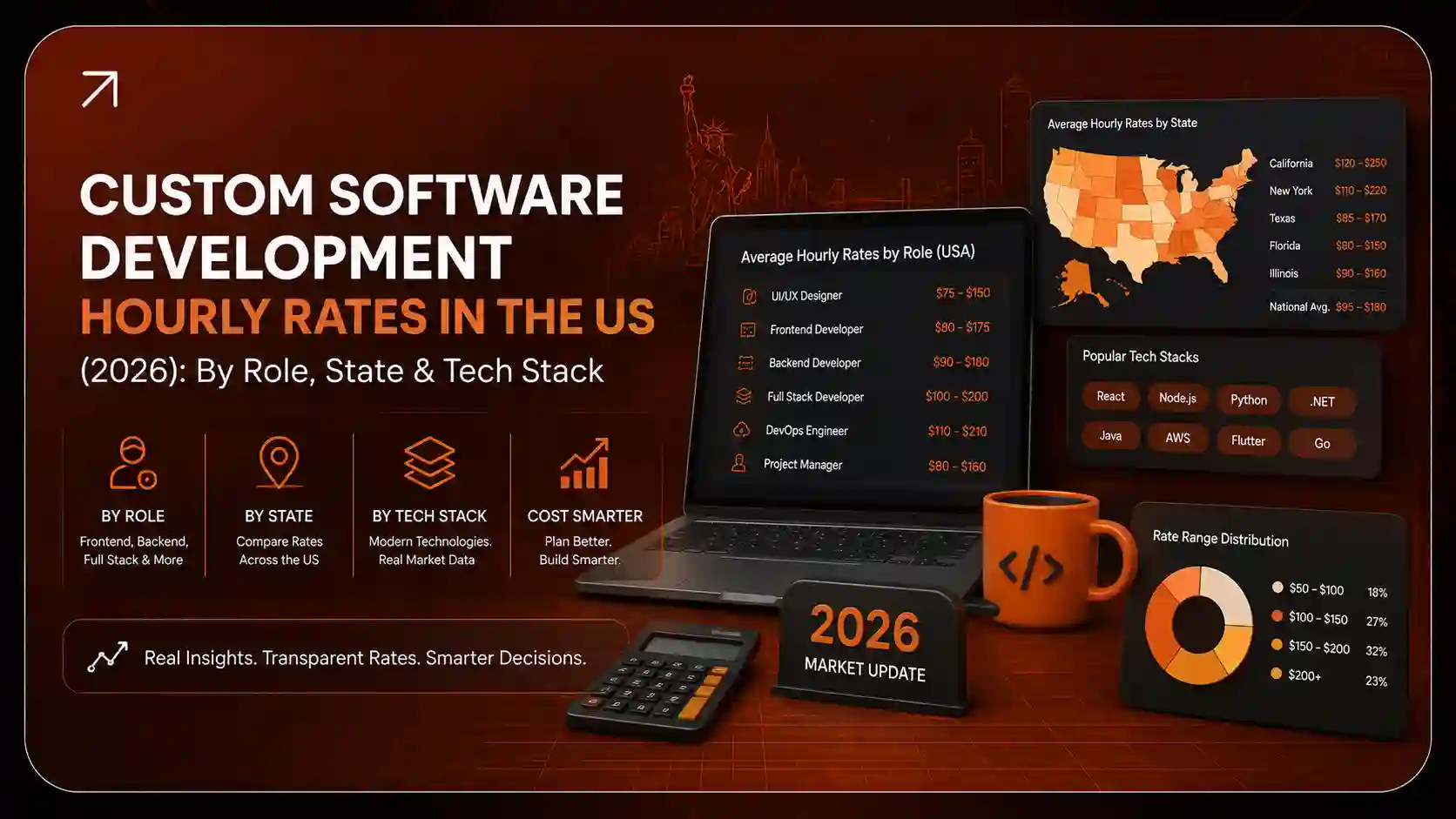
Custom Software Development Hourly Rates in the US (2026): By Role, State & Tech Stack
Ask three US development agencies for a quote and you might hear $75, $150 and $225 an hour. All three can be honest. The gap comes from who’s actually doing the work, where they live, what stack they use, and how the agency runs its business.
This guide explains where those numbers come from. You’ll see custom software development hourly rates in the US for 2026 by role, state, city and tech stack, using federal wage data and current market ranges. You’ll also learn how to turn a salary into a billable rate, how to compare agency, freelance and in-house costs, and how to tell a fair rate from an inflated one.
By the end, you should be able to read any rate card and know what you’re paying for.
In 2026, most US custom software development agencies bill $100 to $200 per hour as a blended rate. Junior developers usually bill $60–$110, senior engineers $130–$200, and AI/ML specialists or architects $150–$275+. Smaller US firms on directories like Clutch often list $50–$99 per hour. Location, seniority and tech stack drive most of the difference.
What Are Custom Software Development Hourly Rates?
A custom software development hourly rate is the price a developer, freelancer or agency charges for one hour of work on software built for your business. It’s the core of most time-and-materials contracts and the base number behind almost every fixed-price quote.
The hourly rate is not the developer’s wage. It also includes:
- Salary and payroll taxes for the person writing the code
- Benefits and the benefits burden (health insurance, retirement, paid leave)
- Overhead such as tools, cloud environments, licenses, office space and management
- Non-billable time for sales, training, bench time and internal meetings
- Profit margin so the company can keep running
That’s why a developer earning $65 an hour on salary might bill $130 to $180 through an agency. The markup isn’t simply profit. Most of it pays for everything around that developer.
Hourly rate vs total project cost
The two are related but answer different questions. The hourly rate tells you the price per hour. The project cost tells you the total budget, which depends on hours, scope and team size.
This article covers rates. For full budget ranges by project type, see our guide to total custom software cost in the USA.
Why Hourly Rates Matter More Than Ever in 2026
Hourly rates shape every major decision in a software project:
- Budget accuracy. A $40/hour difference across a 2,000-hour build adds up to $80,000.
- Vendor comparison. Rates let you compare an Orlando agency, a New York consultancy and a nearshore team on equal terms.
- Team design. Knowing role-based rates helps you balance senior and junior talent instead of overpaying for every task.
- Contract choice. Hourly data helps you decide between time-and-materials, fixed-price and dedicated team models.
- Negotiation. If you know the benchmarks, you can push back on vague or bloated rate cards.
2026 also brings new pressure. AI-assisted coding tools have sped up routine work, while demand for AI, cloud and security specialists keeps rising. As a result, generalist rates are flattening while specialist rates keep climbing.
Average Custom Software Development Hourly Rates in the US (2026 Benchmarks)
Start with what developers actually earn, then layer on agency pricing.
What US software developers earn (federal data)
According to the U.S. Bureau of Labor Statistics OEWS data for software developers, the May 2025 national median wage was $135,980 a year, or about $65.38 an hour. The bottom 10% earned below about $82,460 (roughly $40/hour), and the top 10% earned above about $214,670 (roughly $103/hour).
These figures are base wages only. They leave out benefits, bonuses, equity and the business costs an agency has to cover.
What US clients pay per hour (market rates)
| Provider type (US-based) | Typical hourly rate 2026 | Best for |
|---|---|---|
| Freelance developer (mid to senior) | $60 – $150 | Small, well-defined tasks |
| Small agency / boutique studio | $50 – $120 | MVPs, small business tools |
| Mid-size custom software agency | $100 – $180 | Full product builds, integrations |
| Enterprise consultancy | $175 – $300+ | Regulated, large-scale programs |
| Specialist AI/ML or security firm | $150 – $300+ | Advanced, high-risk work |
Ranges are compiled from BLS wage data, published agency rate cards and listings on Clutch’s software development pricing guide. Actual quotes vary by scope, contract length and team mix.
Key takeaway: A blended rate of about $100–$180 per hour is the realistic middle for a reliable US agency in 2026. Rates far below $75 usually mean offshore delivery, very junior staff or a narrow scope.
Software Development Hourly Rates by Role and Seniority
Not everyone on a project costs the same. A good team mixes senior judgment with mid-level execution.
US hourly rates by role (agency billing, 2026 estimates)
| Role | Typical US hourly rate |
|---|---|
| Junior software developer (0–2 yrs) | $60 – $110 |
| Mid-level developer (3–5 yrs) | $90 – $150 |
| Senior software engineer (6+ yrs) | $130 – $200 |
| Tech lead / software architect | $160 – $250 |
| Full-stack developer | $100 – $175 |
| Front-end developer | $85 – $150 |
| Back-end developer | $100 – $180 |
| Mobile app developer (iOS / Android) | $100 – $175 |
| DevOps / cloud engineer | $110 – $190 |
| Data engineer | $110 – $190 |
| AI / ML engineer | $150 – $275 |
| Cybersecurity engineer | $130 – $220 |
| QA engineer / software tester | $50 – $110 |
| UI/UX designer | $75 – $150 |
| Business analyst | $75 – $140 |
| Project manager / scrum master | $80 – $150 |
| Fractional CTO / CTO-as-a-service | $200 – $350 |
What seniority actually buys you
- Junior developers handle well-scoped tasks under supervision. They’re cheaper per hour but need review time.
- Mid-level developers are the backbone of most builds. They work independently on features.
- Senior engineers and architects make the decisions that prevent expensive rework. One hour of good architecture can save 50 hours of refactoring later.
Practical tip: Don’t staff an entire project with seniors or with juniors. A ratio of about 1 senior to 2–3 mid-level developers keeps quality high and the blended hourly rate reasonable.
Software Developer Hourly Rates by State and City
Location still matters, even with remote work. Agencies price partly on their own payroll, and payroll follows local wages and the cost of living.
BLS median wages in major US markets (May 2025)
| Market | Median annual wage | Approx. wage per hour | Typical agency bill rate* |
|---|---|---|---|
| San Jose / Silicon Valley, CA | $213,110 | ~$102 | $175 – $300 |
| San Francisco, CA | $186,640 | ~$90 | $160 – $275 |
| Seattle, WA | $167,280 | ~$80 | $150 – $250 |
| New York City metro, NY | $166,830 | ~$80 | $150 – $250 |
| Boston, MA | $166,090 | ~$80 | $150 – $240 |
| San Diego, CA | $163,270 | ~$78 | $140 – $225 |
| United States (national) | $135,980 | ~$65 | $100 – $180 |
| Florida (statewide) | $130,980 | ~$63 | $90 – $160 |
| Orlando, FL metro | $129,620 | ~$62 | $85 – $150 |
*Bill-rate ranges are estimates based on typical agency markups over base wages. Wage figures come from BLS OEWS May 2025.
Hourly rate tiers by state
- Highest-cost states: California, Washington, New York, Massachusetts and New Jersey. Expect the top of every range.
- Mid-cost states: Colorado, Virginia, Maryland, Illinois, Texas (Austin and Dallas) and Georgia (Atlanta). Rates sit near or just above the national median.
- Value states: Florida, North Carolina, Arizona, Tennessee, Utah and much of the Midwest. You get US time zones and US contracts at noticeably lower rates.
Software development hourly rates in Orlando and Florida
Orlando has a strong engineering base, built on simulation, defense, gaming, hospitality tech and the University of Central Florida. The BLS median for software developers in the Orlando metro is about $129,620, a bit below the national figure. That shows up directly in agency pricing.
What it means for buyers:
- Orlando hourly rates typically run 15–30% below comparable New York or California rates for similar seniority.
- Tampa, Miami, Jacksonville and Fort Lauderdale follow a similar pattern. Miami runs slightly higher because of fintech and startup demand.
- Smaller Central Florida markets such as Lakeland, Brandon and Wesley Chapel often come in lower still.
- Florida has no state income tax, which helps local firms hire senior talent without pushing rates up as far.
If you’re looking for a local partner, see our custom software development services in Orlando and statewide Florida software development team.
Software developer hourly rates in New York
New York sits near the top of the national range. With a metro median of about $166,830, NYC agencies commonly bill $150 to $250 per hour, and specialists in fintech, healthtech and AI charge more.
NYC vs Orlando example: A senior engineer billing $210/hour in Manhattan might bill about $155/hour from an Orlando-based team with similar experience. Over a 1,500-hour project, that’s about $82,500 in savings with the same time zone and the same legal protections.
Other US cities at a glance
- Austin, Dallas and Houston: mid-to-upper range, rising quickly.
- Chicago, Denver and Atlanta: close to the national median.
- Phoenix, Nashville, Raleigh and Charlotte: good value with growing talent pools.
- Washington, DC: higher rates for government and security-cleared work.
- Los Angeles, Boston and Seattle: upper tier, especially for AI and cloud.
Software Development Hourly Rates by Tech Stack
Hourly rates also depend on what developers build with. Scarce skills cost more. Common skills cost less.
US hourly rates by technology (2026 estimates)
| Tech stack | Typical US hourly rate | Demand level |
|---|---|---|
| JavaScript / React / Next.js | $90 – $165 | Very high, large talent pool |
| Angular / Vue.js | $85 – $155 | Steady |
| Node.js | $95 – $170 | High |
| Python / Django | $100 – $180 | Very high (AI and data) |
| Java / Spring | $100 – $180 | Enterprise standard |
| .NET / C# | $95 – $175 | Enterprise standard |
| PHP / Laravel / WordPress | $60 – $130 | Large pool, lower rates |
| Ruby on Rails | $100 – $175 | Niche but steady |
| Go (Golang) / Rust | $120 – $210 | Scarce, rising |
| Swift (iOS) / Kotlin (Android) | $100 – $180 | High |
| Flutter / React Native | $90 – $165 | High for cross-platform |
| AWS / Azure / Google Cloud | $110 – $200 | Very high |
| Salesforce development | $110 – $200 | Specialist |
| Shopify development | $75 – $150 | E-commerce focused |
| LLM / generative AI integration | $150 – $300+ | Highest demand in 2026 |
| Blockchain / smart contracts | $130 – $250 | Niche |
How your stack choice affects cost
- Mainstream stacks (React, Node.js, Python, .NET) give you the most hiring options and steady rates.
- Niche stacks (Rust, Go, Elixir) can perform very well, but you’ll pay a premium and have fewer people who can maintain the code.
- AI work commands the highest rates because skilled practitioners are still scarce. If you’re planning AI features, read our guide to AI integration in custom software.
For mobile builds, the choice between frameworks changes your hourly cost and team size. See cross-platform vs native app development for the trade-offs.
Agency vs Freelance vs In-House: Comparing the Real Hourly Cost
The rate you see isn’t always the cost you pay. Here’s how the options compare once you include everything.
How to convert a salary into a true hourly cost
- Start with the salary. Example: $135,980 per year.
- Divide by 2,080 hours (40 hours × 52 weeks) to get about $65/hour.
- Add the benefits burden and payroll taxes. These typically add 25–40%, bringing you to about $82–$91/hour.
- Adjust for productive hours. After holidays, PTO, meetings and admin, most employees code about 1,600–1,700 hours a year. Your fully loaded cost rises to about $100–$115/hour.
- Add recruiting, equipment and management time. The real number often lands close to agency pricing.
Side-by-side comparison
| Factor | In-house employee | Freelancer | US agency |
|---|---|---|---|
| Effective hourly cost | $100 – $130 (fully loaded) | $60 – $150 | $100 – $180 |
| Time to start | 2–4 months to hire | Days to weeks | 1–3 weeks |
| Team coverage (QA, PM, design) | Separate hires needed | Usually solo | Included |
| Scalability | Slow | Limited | Fast |
| Risk if someone leaves | High | Very high | Low |
| Best for | Long-term core product | Small, defined tasks | Full builds and scaling |
If you need to grow an existing team quickly, IT staff augmentation lets you add vetted developers at hourly rates without the hiring delays. For a full breakdown of augmentation pricing, see our staff augmentation cost guide.
US vs Nearshore vs Offshore Software Development Rates
Many US companies compare onshore rates against teams abroad. Here’s the 2026 picture.
| Region | Typical hourly rate | Time-zone overlap with US | Notes |
|---|---|---|---|
| United States (onshore) | $100 – $200+ | Full | Strongest legal protection and communication |
| Canada | $90 – $160 | Full | Similar culture and standards |
| Latin America (nearshore) | $40 – $80 | High | Good overlap, growing talent |
| Eastern Europe | $40 – $85 | Partial | Strong engineering depth |
| India / Southeast Asia (offshore) | $25 – $55 | Low | Lowest rates, more management needed |
When paying US rates makes sense
- Your project handles sensitive data (healthcare, fintech, government).
- You need real-time collaboration during US business hours.
- Requirements are unclear or changing, and you need close communication.
- Compliance (HIPAA, PCI DSS, SOC 2) has to be handled correctly the first time.
For a deeper comparison of delivery models, read offshore vs nearshore vs onshore software development.
Key Factors That Affect Custom Software Development Hourly Rates
Beyond role, location and stack, several other factors push rates up or down.
- Project complexity. Integrations, real-time features and complex business logic need senior people.
- Industry and compliance. Healthcare, fintech and legal work carry risk, and rates reflect it. See our fintech software regulations guide for why.
- Contract length. Long-term or dedicated engagements often earn a 5–15% discount.
- Pricing model. Fixed-price quotes include a risk buffer. Time-and-materials rates are usually lower per hour but shift the risk to you.
- Urgency. Rush timelines can add 15–30%.
- Agency reputation and process. Mature QA, documentation and project management raise the rate but lower the total cost.
- Legacy systems. Working with old code needs rare skills. Our legacy software modernization guide explains why.
Red flags in a rate card
- A single flat rate for everyone, with no role breakdown
- No mention of QA, project management or code review
- Rates far below market with vague staff locations
- No written statement of work (SOW) or change-request process
Real-World Examples: What Hourly Rates Look Like in Practice
These scenarios show how hourly rates turn into team decisions.
Example 1: Small business workflow tool (Orlando, FL)
- Team: 1 senior developer (~$150/hr), 1 mid-level developer (~$110/hr), part-time QA (~$75/hr)
- Blended rate: about $115/hour
- Why it works: Local Florida rates keep costs down while keeping US time zones and contracts.
Example 2: Fintech platform (New York, NY)
- Team: Architect (~$230/hr), 2 senior engineers (~$195/hr), security engineer (~$200/hr), QA and PM
- Blended rate: about $185/hour
- Why it costs more: Compliance, security reviews and NYC labor costs all push rates up.
Example 3: Hybrid team for a SaaS startup
- Team: US-based tech lead (~$175/hr) with nearshore developers (~$60/hr)
- Blended rate: about $85/hour
- Why it works: The US lead owns architecture and client communication, and the nearshore developers handle feature work.
Lesson: The cheapest rate rarely gives you the lowest total cost. The right mix of seniority and location usually does. For a walkthrough of planning a build like this, see our MVP development in 90 days guide.
How to Research and Benchmark Developer Rates (Free and Paid Resources)
You don’t have to guess. These resources will help you check any quote.
Free resources
- BLS Occupational Outlook Handbook for software developers: official pay, job outlook and education data
- BLS OEWS wage tables: wages by state and metro area
- Stack Overflow Developer Survey: compensation by role, language and experience
- Levels.fyi: real compensation data from tech employees
- Clutch and GoodFirms: agency hourly rates and verified client reviews
Paid or premium resources
- Glassdoor and Indeed salary insights (premium employer tools)
- Industry compensation surveys from staffing and recruiting firms
- Discovery workshops with a vetted agency, which give you estimates built on your actual scope
A simple 4-step benchmarking process
- Find the BLS median wage for your role and city.
- Multiply by 2 to 2.8 to estimate a reasonable US agency bill rate.
- Compare at least three written quotes with role-based rates.
- Ask each vendor what’s included, especially QA, PM and post-launch support.
Our guide on how to choose a software development company in the USA includes a full vendor checklist.
Why Choose Leads 360 LLC for Custom Software Development
Benchmarks only help if your partner is open about pricing. Here’s why choose Leads 360 LLC when you’re comparing hourly rates:
- Transparent, role-based rate cards. You’ll see who works on your project and what each role costs.
- US-based leadership with Florida roots. Strong engineering talent at rates below the big coastal hubs.
- Flexible engagement models. Hourly, fixed-price, dedicated team or staff augmentation.
- Full-cycle delivery. Discovery, architecture, development, QA, deployment and support.
- Proven processes. Agile delivery, clear software requirements documents and regular demos.
- AI-ready engineering. Practical AI integrations, not hype.
Whether you need a single senior developer or a full product team, our custom software development services in the USA are built to give you predictable costs and solid code.
👉 Explore advanced services at Leads 360 LLC
The Future of Software Development Rates in the USA
Demand for software talent is still strong. The BLS projects software developer employment to grow much faster than the average for all occupations over the coming decade. Several trends will shape rates from here:
- AI changes the rate mix. AI coding assistants reduce time spent on boilerplate, which softens rates for routine work. Rates for AI, ML and data engineering keep rising.
- Specialists earn more. Cloud architects, security engineers and LLM integrators will keep commanding the highest premiums.
- Hybrid teams become standard. More US companies will pair onshore leadership with nearshore execution to manage blended rates.
- Mid-cost cities gain ground. Orlando, Tampa, Raleigh, Austin and Nashville will keep attracting work that once went to New York or San Francisco.
- Outcome-based pricing grows. Some clients will move from pure hourly billing to milestone or value-based contracts.
For the bigger picture, read our overview of custom software development in 2026 and the latest staff augmentation trends.
Frequently Asked Questions
1. What is the average hourly rate for custom software development in the US in 2026?
Most US custom software agencies charge a blended rate of $100 to $180 per hour in 2026. Smaller firms may charge $50–$120, while enterprise consultancies and AI specialists often charge $175–$300+.
2. How much do software developers charge per hour in the US?
US freelance developers usually charge $60 to $150 per hour, depending on skills and experience. Agency developers typically bill $90–$200 per hour because the rate includes QA, project management, overhead and support.
3. How much does a senior software engineer cost per hour in the USA?
A senior software engineer billed through a US agency typically costs $130 to $200 per hour. Architects and tech leads usually range from $160 to $250 per hour.
4. What is the hourly rate for software developers in Orlando, Florida?
Orlando agencies typically bill $85 to $150 per hour. The BLS median wage for Orlando software developers is about $129,620 per year (roughly $62 per hour), below the national median, which keeps local rates competitive.
5. How much does a software developer cost per hour in New York?
New York City agencies commonly charge $150 to $250 per hour. The NYC metro median wage for software developers is about $166,830, one of the highest in the country.
6. Why are US software development rates higher than offshore rates?
US rates reflect higher wages, benefits, taxes and overhead. In return, you get full time-zone overlap, US legal protection, easier communication and stronger compliance with standards like HIPAA and PCI DSS.
7. What is a blended hourly rate in software development?
A blended rate is the average hourly cost across everyone on your project team. For example, one senior at $180 and two mid-level developers at $110 produce a blended rate of about $133 per hour.
8. Is hourly or fixed-price better for custom software projects?
Hourly (time-and-materials) pricing suits projects with changing requirements. Fixed-price suits small, clearly defined scopes. Many teams start with a fixed-price discovery phase and then move to hourly billing.
9. How do I convert a developer’s salary into an hourly rate?
Divide the annual salary by 2,080 hours, then add 25–40% for benefits and payroll taxes. Adjust for roughly 1,650 productive hours a year to get the true fully loaded hourly cost.
10. Did software development rates go up in 2026?
Rates for specialists in AI, cloud and cybersecurity rose in 2026, while rates for routine development stayed fairly flat because AI coding tools improved productivity.
Conclusion: Pay for Value, Not Just the Hourly Number
Custom software development hourly rates in the US for 2026 cover a wide range, from about $50 an hour at small firms to $300+ for elite specialists. Most businesses will land between $100 and $180 per hour for a reliable US team.
To get the best value:
- Compare role-based rates, not single flat numbers
- Consider mid-cost cities like Orlando for US quality at lower rates
- Match your tech stack to the available talent
- Use a blended team of seniors and mid-level developers
- Judge vendors on total cost and outcomes, not hourly price alone
If you’d like a clear, line-by-line rate card for your project, we’re happy to help.
Book a seat for the advanced services offered by Leads 360 LLC. Contact our team today for a free consultation and a transparent hourly estimate built around your goals.