

Fintech App Development: Compliance, Security & Cost (2026 Guide)
Building a fintech app is unlike building almost any other software product. A food delivery app that crashes loses an order. A fintech app that fails can lose people’s money, expose their identities, and bring regulators to your door.
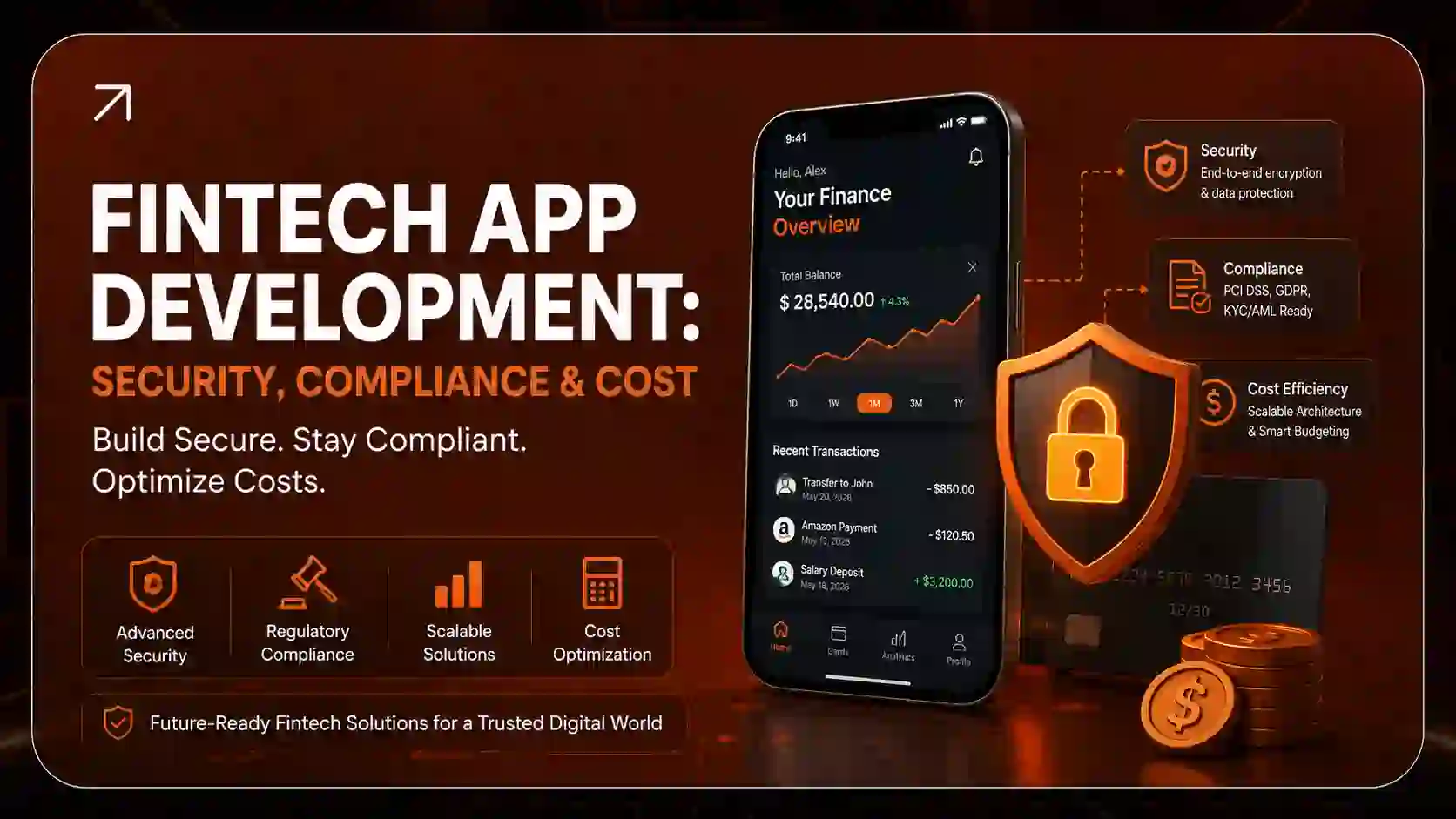
That is why fintech app development comes down to three things: compliance, security, and cost. Get those right and you have a product people can trust. Get them wrong and even a great idea will not survive.
This guide covers what founders, product leaders, and banks need to know in 2026: which US regulations apply, which security controls are required, what fintech app development actually costs, how long it takes, and how to pick a partner who understands all three.
What Is Fintech App Development?
Fintech app development is the process of designing, building, testing, and maintaining software that delivers financial services, such as payments, banking, lending, investing, or insurance, through mobile or web applications. It combines software engineering with financial regulation, data security, and third-party banking integrations.
A fintech app can be as simple as a budgeting tool or as complex as a full digital bank. What separates it from ordinary app development is that every feature touches money, identity, or sensitive financial data, so every feature carries legal weight.
The Main Types of Fintech Apps
Most fintech products fall into a few core categories:
- Payment apps and mobile wallets. Peer-to-peer (P2P) transfers, digital wallets, and merchant payments. Think Venmo, Cash App, and PayPal.
- Neobank and banking apps. Digital-first checking, savings, and debit products, usually built on a partner bank. Chime and Revolut are well-known examples.
- Lending apps. Personal loans, buy now pay later (BNPL), and small business credit, often using AI-driven credit scoring. SoFi started here.
- Investment and wealth management apps. Trading platforms and robo-advisors like Robinhood.
- Crypto wallets and exchanges. Blockchain-based custody, trading, and transfers.
- Insurtech and regtech. Digital insurance products and compliance automation tools.
- Embedded finance. Non-financial businesses adding payments, cards, or lending to their own platforms through banking-as-a-service (BaaS).
When people ask “what are the 4 types of fintech?”, the usual answer is payments, banking, lending, and investing. In practice the lines blur. Many modern apps combine two or three of these.
Why Fintech App Development Matters in 2026
Consumers now expect to open an account in minutes, send money instantly, and see every transaction in real time. Businesses expect the same. Banks, credit unions, and startups that cannot deliver that experience lose customers to those that can.
There are three reasons the stakes are higher now than a few years ago:
- Real-time payments are mainstream. Instant payment rails have raised the bar for speed, and they have also shortened the window to catch fraud.
- Regulators are paying closer attention. After the 2024 collapse of BaaS middleware provider Synapse left many customers unable to reach their funds, regulators and partner banks increased scrutiny of fintech-bank relationships, recordkeeping, and reconciliation.
- AI has changed both sides of security. Fraudsters use AI for deepfakes and synthetic identities. Fintechs use AI to detect fraud and automate compliance. Your app has to keep up.
Expert insight: In 20+ years of watching software markets, the pattern in fintech is consistent. The companies that win are rarely the ones with the flashiest features. They are the ones that treated compliance and security as product features from day one.
Fintech App Development Compliance: What US Regulations Apply?
Fintech app development compliance means building your product so it meets every federal, state, and industry rule that applies to your business model. In the US, the main requirements are KYC and AML controls, data privacy laws, PCI DSS for card data, and state licensing for money movement.
The exact list depends on what your app does. A budgeting app has a lighter load than a lending app. A crypto exchange has one of the heaviest. For a deeper dive, read our guide to fintech software development regulations.
KYC and Customer Due Diligence (CDD)
Know Your Customer (KYC) is how you verify that users are who they claim to be. It typically involves collecting name, date of birth, address, and an identification number, then checking them against trusted data sources.
Customer due diligence (CDD) goes further. It assesses each customer’s risk level and, for business accounts, identifies beneficial owners. Most fintechs use identity verification providers such as Persona, Onfido, Jumio, or Alloy rather than building this from scratch.
AML, the Bank Secrecy Act, and FinCEN
Anti-money laundering (AML) rules come mainly from the Bank Secrecy Act (BSA), enforced by FinCEN. If your app moves money, you will likely need:
- A written AML program with a designated compliance officer
- Ongoing transaction monitoring to flag unusual patterns
- Suspicious Activity Report (SAR) filing procedures
- Recordkeeping and audit trails
- Employee training
What Is the Difference Between KYC and AML?
KYC is one part of AML. KYC verifies a customer’s identity when they sign up. AML is the broader program that monitors transactions, detects suspicious activity, and reports it to authorities throughout the customer relationship.
OFAC Sanctions Screening
Every US person and business must avoid transactions with parties on the sanctions lists maintained by the Office of Foreign Assets Control (OFAC). Fintech apps screen users at onboarding and screen transactions continuously.
PCI DSS Compliance
If your app stores, processes, or transmits cardholder data, you must follow the Payment Card Industry Data Security Standard. The current version is PCI DSS v4.0.1, published by the PCI Security Standards Council.
The simplest way to reduce your PCI burden is to never touch raw card numbers. Using Stripe or another payment processor with tokenization keeps most card data off your servers and shrinks your audit scope dramatically.
Data Privacy: GLBA, CCPA, and GDPR
- GLBA (Gramm-Leach-Bliley Act): Requires financial institutions to explain data-sharing practices and protect customer information. The FTC Safeguards Rule applies to many non-bank fintechs and requires a written information security program.
- CCPA/CPRA: Gives California residents rights over their personal data.
- GDPR: Applies if you serve users in the EU.
Data residency matters too. Know where your data lives and which cloud regions you use.
Consumer Protection and the CFPB
The Consumer Financial Protection Bureau (CFPB) enforces federal consumer financial laws, including rules on unfair, deceptive, or abusive practices, electronic fund transfers (Regulation E), and lending disclosures. If your app offers lending or consumer payments, CFPB rules shape your disclosures, error-resolution process, and complaint handling. Open banking and data-access rules under Dodd-Frank Section 1033 are also worth tracking, since their requirements and timelines have been subject to revision.
SEC and FINRA Compliance
Investment, brokerage, and robo-advisor apps fall under the SEC and FINRA. Depending on your model, you may need to register as a broker-dealer or investment adviser, or partner with a firm that already is one.
Money Transmitter Licenses
If your app holds or moves customer funds, most states require a money transmitter license. This is often the single biggest regulatory hurdle for US fintech startups. Most states manage applications through the Nationwide Multistate Licensing System (NMLS).
SOC 2 Compliance
SOC 2 is not a law. It is an independent audit, based on AICPA Trust Services Criteria, that proves your security controls work. Partner banks, enterprise clients, and BaaS providers increasingly require it before they will sign a contract.
Fintech App Compliance Checklist
Use this as a starting point before launch:
- Define your business model and map which regulations apply
- Decide whether to license directly or partner with a licensed bank or BaaS provider
- Build KYC, CDD, and identity verification into onboarding
- Implement OFAC screening and transaction monitoring
- Write your AML/BSA program and assign a compliance officer
- Minimize PCI DSS scope with tokenization
- Publish clear privacy notices under GLBA and CCPA
- Create audit trails and reporting for every money movement
- Plan for SOC 2 Type I, then Type II
- Schedule annual legal and regulatory reviews
Do I Need a License to Launch a Fintech App in the US?
It depends on your model. Apps that only display financial data usually do not need a license. Apps that hold or transmit customer money typically need state money transmitter licenses, unless they partner with a licensed bank or BaaS provider that holds funds on their behalf.
Do Fintech Startups Need a Banking License?
Most do not. Very few fintechs obtain a bank charter, because the process is long, expensive, and capital-intensive. Instead, they partner with FDIC-insured banks, often through BaaS platforms like Unit or Galileo, or card issuing platforms like Marqeta. The bank holds the deposits and the license, and the fintech owns the customer experience.
Practical tip: A BaaS partnership speeds up launch, but it does not transfer all compliance responsibility. Partner banks will audit your KYC, AML, complaint handling, and reconciliation. Build those controls as if you were the bank.
State-Specific Compliance: Florida, Orlando, and New York
US fintech regulation is a patchwork. Two states that matter a lot for fintech founders are Florida and New York.
Fintech App Development in Florida and Orlando
Florida’s fintech scene has grown rapidly, with activity concentrated in Miami, Tampa, Jacksonville, Fort Lauderdale, Boca Raton, and Orlando. Here is what Florida-based founders need to know:
- Regulator: The Florida Office of Financial Regulation (OFR) oversees money services businesses, consumer finance, and lenders.
- Money transmitter licensing: Florida licenses money transmitters as money services businesses under Chapter 560 of the Florida Statutes, with requirements for net worth, surety bonds, and background checks.
- Data breach rules: The Florida Information Protection Act requires businesses to notify affected residents of certain breaches within tight deadlines.
Orlando, in particular, offers a strong engineering talent pool and lower operating costs than Miami or New York. If you are building locally, our custom software development team in Orlando and broader custom software development services in Florida can help you build with state rules in mind.
Fintech App Development in New York
New York has some of the strictest fintech rules in the country. The New York State Department of Financial Services (NYDFS) is the key regulator.
- NYDFS Part 500: New York’s cybersecurity regulation requires covered entities to maintain a cybersecurity program, appoint a CISO, run risk assessments, enforce multi-factor authentication, and report certain incidents to NYDFS quickly. The 2023 amendments added stricter requirements that phased in through late 2025.
- BitLicense: Any business doing virtual currency activity involving New York or its residents generally needs a BitLicense (or a limited-purpose trust charter). It is known as one of the most demanding crypto licenses in the world.
- Money transmitter license: Required for most money movement businesses serving New Yorkers.
Building for Manhattan, Brooklyn, or Buffalo users means budgeting more time and money for compliance than in most other states.
Fintech App Security: What Your App Needs
Fintech app security means protecting user funds, identities, and financial data with layered controls: encryption, strong authentication, secure APIs, fraud detection, and continuous testing. A secure fintech app assumes it will be attacked and is designed to limit damage when it is.
What Security Features Does a Fintech App Need?
At a minimum, every fintech app should include:
- End-to-end encryption. TLS 1.2 or higher in transit and AES-256 at rest.
- Multi-factor authentication (MFA). Required for login and high-risk actions such as adding a payee.
- Biometric authentication. Face ID and fingerprint login for convenience without weakening security.
- Tokenization. Replace card and account numbers with tokens so real data never sits on your servers.
- Role-based access control (RBAC). Employees see only what their job requires.
- Secure API integration. OAuth 2.0, rate limiting, and strict input validation for every endpoint.
- Fraud detection and prevention. Real-time risk scoring on logins and transactions.
- Audit logs. Tamper-resistant records of every sensitive action.
Zero Trust Architecture
Zero trust means no user, device, or service is trusted by default, even inside your own network. Every request is verified. For fintech, this limits how far an attacker can move if one account or server is compromised.
DevSecOps and a Secure SDLC
Security cannot be a final checklist item. In a secure software development lifecycle (SDLC), security is built into every stage:
- Threat modeling during design
- Secure coding standards during development
- Automated code and dependency scanning in CI/CD pipelines
- Penetration testing before major releases
- Continuous vulnerability assessment after launch
Our software testing best practices guide explains how to fit security testing into a release cycle without slowing delivery.
OWASP Mobile Top 10
The OWASP Mobile Top 10 lists the most common mobile app security risks, such as insecure data storage, weak authentication, and improper credential use. Treat it as a baseline for every fintech mobile app development project.
AI-Powered Fraud Detection
Modern fraud moves fast. Machine learning models can spot account takeovers, synthetic identities, and mule accounts by analyzing device data, behavior, and transaction patterns in real time. Tools like Sardine and Alloy specialize in this. To learn how AI fits into custom builds, see our article on AI integration in custom software.
Secure Cloud Infrastructure
Most fintech apps run on AWS, Azure, or Google Cloud. All three offer strong compliance tooling, but security in the cloud is a shared responsibility. You still own your configuration, access policies, and encryption keys. If you are weighing hosting options, compare them in our cloud vs on-premise guide.
Rule of thumb: If a security control would embarrass you in a breach headline, build it before launch, not after.
Fintech App Development Cost: A Realistic Breakdown
How much does it cost to build a fintech app? In 2026, a fintech MVP typically costs $50,000 to $150,000. A mid-level app with banking integrations and stronger compliance runs $150,000 to $350,000. Enterprise-grade platforms often exceed $350,000 and can pass $1 million. Licensing, audits, and third-party APIs are extra.
These are typical market ranges, not fixed quotes. Your actual fintech app development cost depends on features, compliance scope, team location, and integrations. For general app pricing context, see how much it costs to build an app in 2026.
Fintech App Cost by Product Tier
MVP ($50,000 to $150,000, about 3 to 6 months): Core onboarding with KYC, one primary feature such as P2P payments or account linking, basic security, one platform or cross-platform build, and a BaaS or payment partner.
Mid-level product ($150,000 to $350,000, about 6 to 12 months): Native or high-quality cross-platform apps, multiple financial features, fraud monitoring, admin dashboards, analytics, and SOC 2 readiness.
Enterprise platform ($350,000 to $1M+, about 12 to 18+ months): Core banking integration, microservices architecture, advanced AI, multi-state or multi-country compliance, high availability, and dedicated security operations.
Cost to Build Specific Fintech Apps
- Payment app like Venmo: Roughly $80,000 to $250,000, depending on P2P features, ACH and real-time payments, and social features.
- Neobank app like Chime: Roughly $150,000 to $500,000 or more, driven by BaaS integration, card issuing, and deposit features.
- Lending app like SoFi: Roughly $120,000 to $400,000, driven by credit scoring, underwriting logic, and loan servicing.
- Crypto wallet or exchange: Roughly $100,000 to $500,000 or more, with security and licensing costs often higher than the build itself.
- Robo-advisor app: Roughly $120,000 to $350,000, depending on portfolio logic and SEC registration needs.
Hourly Rates for Fintech Developers
Team location has a huge effect on budget:
- US-based developers: about $100 to $200+ per hour
- Eastern Europe and Latin America: about $40 to $90 per hour
- South Asia: about $25 to $60 per hour
Cheaper is not always cheaper. A team that does not understand financial regulation can create rework that costs more than the savings. Our breakdown of offshore vs nearshore vs onshore software development explains the trade-offs.
Hidden Costs Most Founders Miss
- Third-party API fees. Plaid, Stripe, KYC vendors, and fraud tools usually charge per user or per transaction.
- Licensing and legal costs. State money transmitter licensing across many states, including surety bonds and legal fees, can run into the hundreds of thousands of dollars.
- Compliance audits. SOC 2, PCI DSS assessments, and penetration tests each carry annual costs.
- Ongoing maintenance. Plan for 15% to 25% of your initial build cost every year.
How Much Does It Cost to Maintain a Fintech App per Year?
Most fintech apps cost 15% to 25% of the original build cost per year to maintain. That covers security patches, OS updates, regulatory changes, cloud hosting, API fees, monitoring, and bug fixes. Apps with heavy compliance needs land at the higher end.
Fintech App Development Process: Step by Step
Here is how to build a fintech app that is secure and compliant from the start. For a general view of app stages, see our 7 stages of mobile app development.
- Discovery and regulatory mapping. Define your users, business model, and the exact regulations that apply. Bring in legal counsel early.
- Choose your licensing path. Decide between direct licensing and a bank or BaaS partnership.
- Write your requirements. Document features, compliance controls, and integrations. Our software requirements document guide shows how.
- UX/UI design. Design onboarding that is simple for users but still collects what KYC requires.
- Architecture and tech stack. Plan for security, scalability, and auditability.
- Development with DevSecOps. Build in short sprints with automated security checks.
- Integrations. Connect payment gateways, Plaid, KYC vendors, and BaaS partners. See our API integration services guide.
- Testing. Run functional, performance, security, and penetration testing.
- Compliance review and launch. Get partner bank sign-off and complete required audits.
- Monitor and improve. Track fraud, uptime, and regulatory changes after launch.
How Long Does It Take to Build a Fintech App?
A fintech MVP usually takes 4 to 6 months. A full-featured fintech app takes 9 to 18 months. Licensing can add 6 to 18 months on its own, which is why many startups launch through a BaaS partner while their own licenses are pending.
Best Tech Stack for Fintech App Development
There is no single best stack, but proven choices exist:
- iOS: Swift
- Android: Kotlin
- Cross-platform: Flutter or React Native, which work well for many fintech MVPs
- Backend: Java, Node.js, or Python, often in a microservices architecture
- Databases: PostgreSQL for transactional data, with strong encryption
- Cloud: AWS, Azure, or Google Cloud
- Integrations: Plaid for account linking, Stripe for payments, Twilio for communications, Marqeta for card issuing
What Is the Best Tech Stack for a Fintech App?
A reliable fintech stack uses Swift and Kotlin (or Flutter and React Native for cross-platform), Java, Node.js, or Python on the backend, PostgreSQL for transactional data, and AWS, Azure, or GCP for hosting. The best stack is the one your team can secure, audit, and scale.
Unsure whether to go native or cross-platform? Read our comparison of cross-platform vs native app development.
In-House vs Outsourced Fintech App Development
Should you build in-house or outsource? In-house teams give you more control and long-term knowledge, but hiring experienced fintech engineers is slow and expensive. Outsourcing to a fintech app development company is faster and often cheaper, provided the partner has real compliance and security experience.
Many companies choose a hybrid model: a small internal product and compliance team, supported by an external development partner or augmented staff. Learn more in our software development outsourcing guide or explore staff augmentation services.
How to Choose a Fintech App Development Company
Ask every candidate these questions:
- Have you built apps that passed a partner bank review or a SOC 2 audit?
- How do you handle KYC, AML, and PCI DSS scope?
- What does your secure SDLC look like?
- Who owns the code and intellectual property?
- How do you price change requests and post-launch support?
For a full framework, see how to choose a mobile app development company.
What Is the Cheapest Way to Launch a Fintech MVP?
The cheapest path to a fintech MVP is to narrow your scope to one core feature, use a cross-platform framework, and rely on BaaS, Plaid, Stripe, and third-party KYC vendors instead of building infrastructure yourself. This avoids early licensing costs and cuts both budget and timeline.
Our 90-day MVP development guide walks through how to scope an MVP that tests your idea without overbuilding.
Founder tip: Cut features, never controls. An MVP can skip a rewards program. It cannot skip MFA, KYC, or encryption.
Real-World Fintech Examples and Lessons
- Venmo showed that a social layer can make payments feel effortless, but its early privacy settings drew regulatory attention. Lesson: privacy defaults matter.
- Chime proved the bank-partnership model can scale to millions of users without a bank charter.
- Robinhood made investing accessible but also faced regulatory penalties, showing that growth does not shield a fintech from oversight.
- Revolut and Wise expanded globally by treating multi-country licensing as a core strategy, not an afterthought.
- The Synapse collapse (2024) showed what happens when ledger reconciliation and BaaS oversight fail. Customers were cut off from their money, and the industry tightened its standards.
How Do Fintech Apps Make Money?
Fintech apps typically earn revenue through:
- Interchange fees on debit and credit card transactions
- Transaction fees on payments, transfers, or currency exchange
- Subscription plans for premium features
- Interest income on loans or BNPL products
- Payment for order flow or trading fees in investing apps
- B2B and API licensing for embedded finance
Fintech Industry Demand and Career Opportunities in the USA
Demand for fintech software development talent remains strong across the US. Banks, credit unions, insurers, and startups all need engineers who understand payments, security, and regulation. Roles in high demand include:
- Fintech mobile and backend developers
- Application security and DevSecOps engineers
- Compliance and regtech specialists
- Fraud and data science engineers
- Product managers with financial services experience
Experienced fintech engineers in the US often earn well above general software developer averages, especially in hubs like New York, San Francisco, Charlotte, Austin, and Miami. Fintech activity is also spreading across Atlanta, Chicago, Dallas, Denver, and Orlando, giving companies more hiring options.
How to Learn Fintech Development (Free and Paid Resources)
Free resources:
- Plaid and Stripe developer documentation
- OWASP Mobile Security Testing Guide
- FinCEN, CFPB, and NYDFS guidance pages
- NIST Cybersecurity Framework materials
Paid resources:
- Certifications such as CISSP or CISA for security and audit roles
- ACAMS certification for AML specialists
- University fintech certificate programs
- Cloud security certifications from AWS, Azure, or Google Cloud
Biggest Risks in Fintech App Development
- Underestimating compliance. Licensing and audits take longer than code.
- Weak vendor oversight. Your partners’ failures become your failures.
- Security shortcuts. Breaches destroy trust faster than any competitor.
- Poor ledger design. If balances do not reconcile, nothing else matters.
- Scaling problems. Architecture that works for 1,000 users can break at 100,000.
- Choosing the wrong team. Generalist developers often miss fintech-specific risks.
Fintech App Development Best Practices
- Treat compliance as a product requirement, not a legal afterthought
- Minimize sensitive data. Do not store what you do not need
- Use proven vendors for KYC, payments, and card issuing
- Build double-entry ledgers and daily reconciliation from day one
- Automate security testing in every deployment
- Design scalable architecture with microservices where it makes sense
- Document everything for auditors and partner banks
- Review regulations every year, because they change
Why Choose Leads 360 LLC for Fintech App Development
Choosing a fintech app development company is a decision you live with for years. Here is why businesses choose Leads 360 LLC:
- Compliance-aware engineering. We build KYC, AML, audit trails, and PCI-conscious architecture into the plan from the first sprint.
- Security by design. Secure SDLC, DevSecOps pipelines, encryption, MFA, and penetration testing come standard.
- Transparent pricing. Clear estimates, clear milestones, and no surprise invoices. See how we approach custom software development cost in the USA.
- Flexible engagement models. Full project delivery, dedicated teams, or staff augmentation to strengthen your in-house team.
- US-focused expertise. We support clients nationwide through our custom software development services in the USA, with local teams in Florida and Orlando.
- End-to-end delivery. From discovery and design to launch, maintenance, and growth through our full range of services.
Explore advanced services at Leads 360 LLC to see how we take fintech products from idea to launch.
Frequently Asked Questions About Fintech App Development
How much does it cost to build a fintech app?
A fintech app typically costs $50,000 to $150,000 for an MVP, $150,000 to $350,000 for a mid-level product, and $350,000 to $1 million or more for an enterprise platform. Final cost depends on features, compliance scope, integrations, team location, and licensing needs.
What are the main compliance requirements for a fintech app?
Most US fintech apps need KYC and customer due diligence, AML controls under the Bank Secrecy Act, OFAC sanctions screening, data privacy compliance under GLBA and CCPA, PCI DSS for card data, and state money transmitter licenses if they hold or move customer funds.
How long does it take to build a fintech app?
A fintech MVP usually takes 4 to 6 months, while a full-featured app takes 9 to 18 months. State licensing can add 6 to 18 months, so many startups launch through a licensed bank or BaaS partner first to reach the market sooner.
What is PCI DSS and does my fintech app need it?
PCI DSS is the security standard for any business that stores, processes, or transmits cardholder data. If your app handles card payments, it applies. Using a tokenized payment processor like Stripe keeps card data off your servers and greatly reduces your compliance scope.
Is it hard to get a fintech license in the US?
Yes, it can be. Money transmitter licenses are issued state by state, each with its own net worth, bonding, and background check requirements. Gaining nationwide coverage can take over a year and cost hundreds of thousands of dollars, which is why bank partnerships are popular.
Which regulators oversee fintech apps in the US?
Key federal regulators include the CFPB, FinCEN, OFAC, the FTC, the SEC, and FINRA, plus bank regulators that oversee partner banks. State regulators, such as the NYDFS in New York and the Office of Financial Regulation in Florida, handle licensing and state-level rules.
How do you keep a fintech app secure?
Keep a fintech app secure by using end-to-end encryption, multi-factor and biometric authentication, tokenization, role-based access control, and secure APIs. Add real-time fraud detection, follow the OWASP Mobile Top 10, and run regular penetration tests and vulnerability scans throughout the app’s lifecycle.
What is SOC 2 and why does it matter for fintech?
SOC 2 is an independent audit that shows your company’s security, availability, and confidentiality controls work as designed. It is not legally required, but partner banks, BaaS providers, and enterprise customers often demand it before signing contracts, making it essential for fintech growth.
Can I use BaaS to launch a fintech app faster?
Yes. Banking-as-a-service providers let you offer accounts, cards, and payments through a licensed partner bank, often cutting months off your launch. You still need strong KYC, AML, and reconciliation controls, because partner banks will audit your compliance program closely.
Should I build a fintech app in-house or outsource it?
Outsourcing is usually faster and more cost-effective for startups, provided the partner has proven fintech compliance and security experience. In-house teams offer more control long term. Many companies use a hybrid model, keeping product and compliance internal while outsourcing development.
Conclusion: Build a Fintech App People Can Trust
Successful fintech app development is not about launching the most features. It is about launching a product that is compliant, secure, and built on a realistic budget. Map your regulations early. Design security into every layer. Plan your costs, including licensing, audits, and maintenance, before you write the first line of code.
Do that, and you give users the one thing every fintech app needs to survive: trust.
Whether you are building a payment app, a neobank, a lending platform, or a crypto wallet, the right partner makes all the difference. Leads 360 LLC brings compliance-aware engineering, security-first development, and transparent pricing to every fintech project.
Ready to start? Book a seat at Advance Services offered by Leads 360 LLC and get a tailored plan, timeline, and cost estimate for your fintech app.
About the author: This guide was prepared by the Leads 360 LLC Software Development Team, which builds custom software, mobile apps, and secure cloud platforms for US businesses. Note: this article is for general information and is not legal advice. Always confirm licensing and compliance requirements with qualified counsel.